
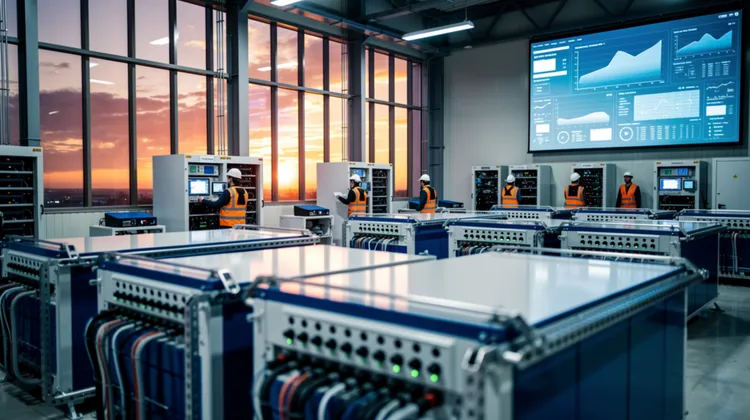
The global energy transition is accelerating, but the conversation often centers on generation—solar farms, wind turbines, and nuclear reactors. Yet the unsung hero of a decarbonized grid is storage. While lithium-ion batteries have dominated headlines for short-duration applications, a quiet revolution is underway in long-duration energy storage (LDES). These technologies, designed to discharge power for 10 hours or more, are critical for integrating high penetrations of intermittent renewables. As utilities and grid operators grapple with the limitations of lithium, a new generation of non-lithium storage solutions is emerging, each with distinct trade-offs in scalability, environmental footprint, and lifecycle costs.
The Case for Long-Duration Storage
The fundamental challenge of renewable energy is its variability. Solar generation peaks at midday, while wind often blows strongest at night. Without storage, grid operators must rely on fossil fuel peaker plants to fill the gaps. LDES offers a path to displace these plants, providing reliable power during multi-day weather events, seasonal shifts, or grid emergencies.
According to the Long Duration Energy Storage Council, achieving net-zero emissions by 2050 will require 85-140 terawatt-hours of LDES capacity globally. This is not a niche market—it is a foundational infrastructure need. Lithium-ion batteries, while effective for 4-6 hour durations, become economically and physically impractical for longer cycles due to degradation, safety concerns, and material constraints.
The Contenders: Non-Lithium Technologies
Flow Batteries: The Scalable Workhorse
Flow batteries, particularly vanadium redox and iron-based chemistries, are leading the LDES charge. Unlike lithium-ion, they store energy in liquid electrolytes housed in external tanks. This decoupling of power and energy capacity means scaling up is as simple as adding larger tanks. Iron flow batteries, such as those from ESS Inc., use abundant, low-cost materials, reducing supply chain vulnerabilities.
- Scalability: Extremely high. Can be designed for 4-12 hour durations with minimal degradation over 20+ years.
- Environmental Footprint: Low. No toxic materials in iron-based systems; vanadium mining has moderate impacts but is recyclable.
- Lifecycle Costs: Levelized cost of storage (LCOS) is projected to drop below $50/MWh by 2030, competitive with pumped hydro.
Gravity-Based Storage: The Physics of Height
Gravity storage systems, like Energy Vault's concrete blocks or pumped hydro, convert potential energy to electricity. Modern gravity solutions avoid the geographic constraints of pumped hydro by using purpose-built structures or abandoned mineshafts.
- Scalability: Moderate. Requires large physical footprints or vertical structures, but can achieve 8-24 hour durations.
- Environmental Footprint: Low during operation, but construction materials (concrete, steel) have embodied carbon.
- Lifecycle Costs: High upfront capital, but low operational costs. LCOS estimates range from $60-$100/MWh for 10-hour systems.
Compressed Air Energy Storage (CAES)
CAES systems compress air into underground caverns or above-ground tanks, releasing it through turbines to generate electricity. Advanced adiabatic CAES eliminates the need for natural gas heating, making it truly zero-emission.
- Scalability: High for geological storage; limited for above-ground due to tank costs.
- Environmental Footprint: Minimal for underground storage; surface systems have moderate land use.
- Lifecycle Costs: 8-12 hour systems show LCOS of $80-$120/MWh, with potential to drop below $60/MWh with scale.
Thermal Storage: The Heat Battery
Thermal storage uses molten salt, phase-change materials, or solid media to store heat, which is then converted to electricity via steam turbines or thermoelectric generators. It is particularly suited for industrial applications and concentrated solar power.
- Scalability: Very high for utility-scale molten salt systems.
- Environmental Footprint: Low; materials are abundant and non-toxic.
- Lifecycle Costs: LCOS of $40-$70/MWh for 10-hour systems, making it one of the cheapest options.
Evaluating Scalability: Beyond the Hype
Scalability is not just about technical potential—it is about supply chains, manufacturing capacity, and grid integration. Flow batteries benefit from modular designs that can be factory-assembled, reducing on-site construction. Gravity systems require heavy civil engineering, which can bottleneck deployment. CAES depends on suitable geology, limiting its geographic reach.
A 2023 study from the National Renewable Energy Laboratory found that iron flow batteries could meet 30% of U.S. LDES needs by 2035 if manufacturing scales as projected. However, vanadium supply remains a concern, with 80% of global production concentrated in China, Russia, and South Africa.
Environmental Footprint: A Lifecycle Perspective
Every storage technology has an environmental price. Lithium-ion batteries have high mining impacts for cobalt, lithium, and nickel. Non-lithium alternatives generally score better, but not uniformly.
- Flow batteries: Iron-based systems have minimal toxicity; vanadium requires careful recycling.
- Gravity storage: Concrete production accounts for 8% of global CO2 emissions, though new low-carbon cements are emerging.
- CAES: Underground storage has low surface impact, but compressed air systems can leak, affecting local air quality.
- Thermal storage: Molten salt is non-toxic, but steam turbines have water consumption needs.
A 2024 lifecycle analysis by the Fraunhofer Institute found that iron flow batteries have a carbon footprint 60% lower than lithium-ion over a 25-year lifespan, when considering manufacturing, operation, and end-of-life.
Lifecycle Costs: The Real Economics
The levelized cost of storage is the ultimate metric for utility adoption. Lithium-ion currently dominates at $100-$150/MWh for 4-hour systems, but for 10-hour applications, its costs rise to $200-$300/MWh due to additional battery packs and cooling infrastructure.
Non-lithium technologies show a different cost curve:
- Iron flow: $80-$120/MWh for 10-hour systems, with projections below $50/MWh by 2030.
- Gravity: $60-$100/MWh, but with high upfront capital.
- CAES: $80-$120/MWh, improving with advanced adiabatic designs.
- Thermal: $40-$70/MWh, making it the cheapest option for 10+ hour durations.
A key advantage of these technologies is longevity. Lithium-ion batteries degrade after 5,000-10,000 cycles, while flow batteries can exceed 20,000 cycles with minimal loss. This translates to lower replacement costs over a 30-year project life.
The Road Ahead: Integration Challenges
Despite their promise, non-lithium LDES technologies face hurdles. Grid interconnection queues are backlogged, permitting processes are slow, and utility procurement cycles are conservative. Additionally, current market structures often undervalue long-duration storage, paying for capacity rather than resilience.
The U.S. Department of Energy's Long Duration Storage Shot program aims to reduce LDES costs to $50/MWh by 2030, a target that several technologies are on track to meet. Policy support, such as the Inflation Reduction Act's investment tax credit for standalone storage, is accelerating deployment.