
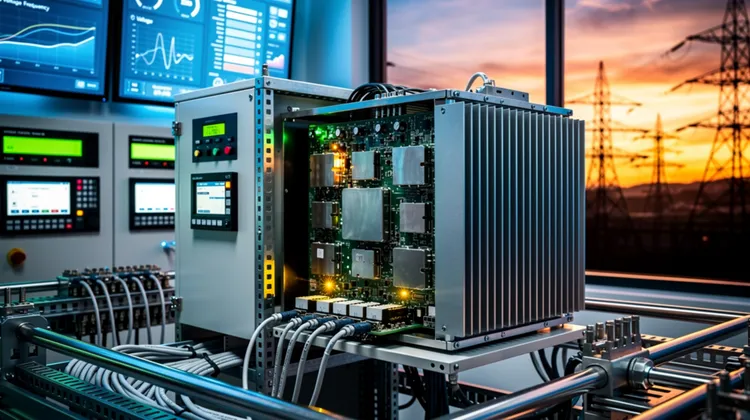
For over a century, the humble distribution transformer has been the unsung workhorse of the electrical grid. These passive devices step down voltage from medium to low levels, enabling safe power delivery to homes and businesses. But the grid is no longer a one-way street. With the rise of solar panels, battery storage, and electric vehicle charging, distribution networks must now handle bidirectional energy flows and variable power quality. Enter the solid-state transformer (SST)—a power electronics-based device that promises to transform the distribution network from a passive conduit into an active, intelligent node.
Unlike traditional transformers that rely on magnetic cores and copper windings, SSTs use high-frequency power electronics to convert and regulate voltage. This fundamental shift in design unlocks capabilities that were previously impossible with conventional iron-and-copper technology. The result is a device that can actively manage voltage, correct power factor, and seamlessly integrate DC-based renewable sources, all while maintaining high efficiency across a wide load range.
How Solid-State Transformers Work
At its core, an SST consists of three main stages: an input rectifier, a high-frequency isolation stage, and an output inverter. The input stage converts incoming AC power to DC, which is then switched at frequencies typically ranging from 10 kHz to 100 kHz through a high-frequency transformer. This high-frequency operation dramatically reduces the size and weight of the magnetic core compared to a 50/60 Hz transformer. The output stage then converts the DC back to AC at the desired voltage and frequency.
The key enabler is modern wide-bandgap semiconductors, such as silicon carbide (SiC) and gallium nitride (GaN), which can handle high voltages and switch at high frequencies with minimal losses. According to a 2023 report by the International Energy Agency, the global market for wide-bandgap power devices is projected to grow at a compound annual rate of 18% through 2030, driven largely by utility and industrial applications.
Active Voltage Regulation and Power Quality
One of the most significant advantages of SSTs is their ability to perform active voltage regulation. Traditional transformers have a fixed turns ratio, meaning the output voltage varies with load and input voltage fluctuations. SSTs, by contrast, can adjust their output voltage in real time—compensating for voltage sags, swells, and harmonics—without the need for external tap changers or capacitor banks.
This capability is critical for distribution networks hosting distributed energy resources (DERs). For example, when a cloud passes over a solar farm, the sudden drop in generation can cause a voltage sag on the feeder. An SST can respond in milliseconds to stabilize the voltage, preventing sensitive equipment from tripping offline. Studies from the Electric Power Research Institute (EPRI) indicate that SSTs can improve voltage regulation accuracy to within ±1% of nominal, compared to ±5% for conventional transformers.
Bidirectional Energy Flow and Renewable Integration
The modern grid is increasingly bidirectional. Solar panels on homes export excess power during the day, while electric vehicle batteries may both charge from and discharge back to the grid. Traditional transformers are inherently unidirectional—they cannot handle reverse power flow without risking saturation or overheating. SSTs, with their dual-converter architecture, are naturally bidirectional.
This bidirectional capability is essential for integrating DC-based renewable sources. Solar panels generate DC power, and battery storage systems also operate natively on DC. With an SST, a DC microgrid can connect directly to the distribution network without the need for multiple AC/DC conversion stages, reducing losses by up to 10% compared to conventional setups. A 2022 field trial by the National Renewable Energy Laboratory (NREL) demonstrated that an SST-enabled microgrid achieved 97.5% round-trip efficiency for energy storage applications.
Enhanced Grid Flexibility and Islanding
SSTs also enable advanced grid functions like intentional islanding. In the event of a upstream fault, an SST can isolate a section of the distribution network and continue to operate as a standalone microgrid, powered by local solar and battery resources. This capability is increasingly valuable for critical infrastructure such as hospitals, data centers, and military bases that require uninterrupted power.
The flexibility extends to voltage and frequency support. SSTs can inject or absorb reactive power to maintain power factor near unity, reducing losses on the distribution feeder. They can also provide synthetic inertia, mimicking the rotational mass of traditional generators to stabilize frequency during disturbances. According to a 2024 study published in IEEE Transactions on Power Electronics, SST-based grid support can reduce the need for traditional synchronous condensers by up to 30% in distribution networks with high renewable penetration.
Size, Weight, and Thermal Management
Beyond electrical performance, SSTs offer compelling physical advantages. Because they operate at high frequencies, the magnetic components are significantly smaller than their 50/60 Hz counterparts. A typical 1 MVA solid-state transformer occupies about 40% less volume and weighs 50% less than a conventional distribution transformer of the same rating. This makes SSTs ideal for space-constrained urban substations, offshore wind platforms, and mobile military applications.
Thermal management, however, remains a challenge. Power electronics generate heat that must be efficiently dissipated to maintain reliability. Advanced cooling solutions—including liquid cooling and heat pipe technologies—are being developed to handle the thermal loads. Manufacturers like ABB and Siemens have demonstrated SST prototypes with forced air cooling that maintain junction temperatures below 125°C at full load, ensuring a lifespan comparable to conventional transformers.
Challenges and Current Limitations
Despite their promise, SSTs face several barriers to widespread adoption. The most significant is cost. Wide-bandgap semiconductors remain expensive compared to silicon, and the complex control electronics add manufacturing complexity. Current estimates place the per-unit cost of an SST at two to three times that of a conventional transformer of equivalent rating. However, costs are falling rapidly as manufacturing scales up and new fabrication techniques emerge.
Reliability is another concern. Power electronics have historically lower mean time between failures (MTBF) than passive magnetic devices. However, advances in redundancy design and condition monitoring are closing this gap. The U.S. Department of Energy’s Advanced Research Projects Agency-Energy (ARPA-E) has funded several projects targeting SST reliability improvements, with a goal of achieving 30-year service life by 2028.
The Road Ahead
Solid-state transformers represent a paradigm shift in distribution network design. They are not merely replacements for conventional transformers but enablers of a fully digital, bidirectional, and resilient grid. As renewable penetration continues to grow and grid modernization accelerates, SSTs will play an increasingly central role in managing the complexity of tomorrow’s power systems.
Early adopters include utility-scale solar farms, electric vehicle charging hubs, and critical infrastructure facilities requiring high power quality. Pilot projects are underway in Europe, North America, and Asia, with commercial deployments expected to begin by 2027. For utilities and industrial operators, understanding SST technology today is essential for planning the grid of tomorrow.