
The global energy transition is rewriting the rules of power transmission. As nations race to decarbonize, they are discovering that traditional alternating current (AC) grids, while robust, have fundamental limitations when it comes to moving large amounts of power over long distances or across bodies of water. Enter the high-voltage direct current (HVDC) interconnector—a technology that is quietly reshaping the geography of energy markets. These long-distance DC links are no longer experimental; they are critical infrastructure for national energy security and cross-border stability.
The engineering case for HVDC over AC is compelling. For long-distance transmission, AC lines suffer from significant reactive power losses and require costly compensation equipment every 50 to 100 kilometers. HVDC, by contrast, eliminates reactive power issues entirely. A single HVDC link can transmit up to 3,000 megawatts over 1,000 kilometers with losses of only 3-5%, compared to 8-10% for an equivalent AC line. This efficiency is driving a global boom in HVDC projects, from the North Sea Link connecting Norway and the UK to the massive ±800 kV links in China.
The Engineering Behind the Bridge
Modern HVDC systems rely on voltage source converters (VSC), specifically modular multilevel converters (MMC), which offer several advantages over older line-commutated converter (LCC) technology. VSC systems can independently control active and reactive power, making them ideal for connecting weak AC grids or integrating offshore wind farms. They also allow for black-start capability—the ability to energize a dead grid—which is a critical feature for emergency restoration.
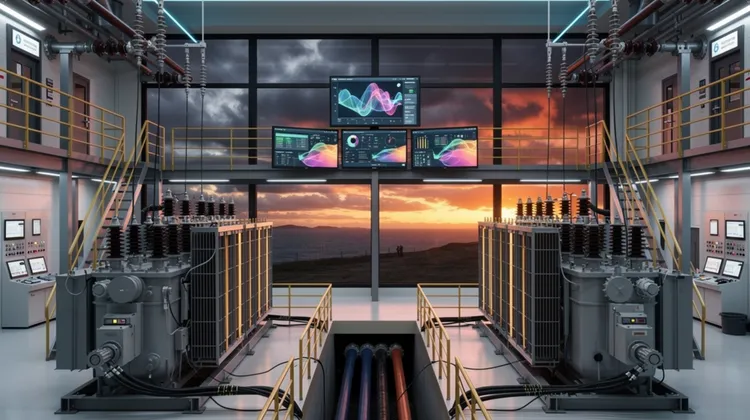
The engineering challenges, however, are substantial. Converter stations are the heart of any HVDC link, and they are massive, complex facilities. Each station contains hundreds of IGBT modules, cooling systems, control electronics, and harmonic filters. The insulation requirements for DC are fundamentally different from AC, requiring specialized transformer designs and cable systems. For submarine cables, the challenge is even greater: the cable must withstand high pressure, saltwater corrosion, and mechanical stress from sea currents and anchors.
Benefits for Energy Security
HVDC interconnectors provide three distinct benefits for energy security:
- Diversification of supply: By connecting two different power systems, interconnectors allow countries to share generation resources. When one region has excess wind or solar power, it can export to a neighboring region experiencing a deficit. This reduces reliance on any single fuel source or generation type.
- Frequency and voltage support: HVDC links can rapidly adjust power flow to help stabilize grid frequency. A sudden loss of a large power plant in one country can be compensated by importing power from another country within milliseconds. This is a far faster response than traditional thermal plants.
- Emergency backup: In the event of a major blackout, an interconnector can provide the initial power needed to restart the grid. This is particularly valuable for islands or regions with limited interconnection.
Cross-Border Market Integration
Beyond physical reliability, HVDC interconnectors are powerful tools for market integration. The European Union, for example, has established a target of 15% interconnection capacity relative to installed generation by 2030. Projects like the Viking Link between Denmark and the UK, and the EuroAsia Interconnector linking Israel, Cyprus, and Greece, are designed to create a single European electricity market.
The economic benefits are significant. A study by the European Commission found that increased interconnection could reduce wholesale electricity prices by 5-10% across the continent. For consumers, this translates to lower bills. For generators, it means access to a larger market with more diverse demand patterns.
The Challenge of Standardization
One of the most persistent engineering hurdles is the lack of global standardization. Unlike AC systems, where voltage and frequency are standardized within regions, HVDC systems are often custom-designed for each project. Different manufacturers use different control protocols, communication systems, and converter topologies. This makes it difficult to connect multiple HVDC links into a larger DC grid.
The industry is working on solutions. The International Electrotechnical Commission (IEC) has published standards for HVDC system design and testing, but full interoperability remains elusive. Multi-terminal HVDC grids, such as the planned North Sea Wind Power Hub, will require advances in DC circuit breakers and control systems. These components are still in the early stages of commercial deployment.
Environmental and Regulatory Considerations
HVDC interconnectors also have environmental implications. Submarine cables can disturb marine habitats during installation, and land-based converter stations require significant real estate. However, the environmental benefits often outweigh the costs. By enabling the integration of remote renewable resources, HVDC reduces the need for fossil fuel generation. A single interconnector can displace millions of tons of CO2 annually.
Regulatory frameworks are also evolving. Cross-border interconnectors require complex agreements between national grid operators, regulators, and governments. Issues such as cost allocation, congestion management, and emergency protocols must be resolved before construction can begin. The European Union's TEN-E regulation provides a framework for identifying and funding Projects of Common Interest (PCI), which streamlines the approval process.
The Future of Long-Distance Links
The next frontier for HVDC is the development of ultra-high voltage direct current (UHVDC) systems at ±800 kV and above. China is already operating several UHVDC lines, including the 3,300-kilometer Changji-Guquan link, which transmits 12,000 MW. These systems are essential for connecting remote hydro, solar, and wind resources to load centers thousands of kilometers away.
Another promising development is the use of HVDC for offshore wind energy. The Dogger Bank Wind Farm in the UK, the world's largest offshore wind project, will use HVDC technology to transmit power to shore. This sets a precedent for future offshore wind farms, which will increasingly rely on DC links to overcome the limitations of AC cables.
As the energy transition accelerates, HVDC interconnectors will become the backbone of a truly global electricity market. The engineering challenges are real, but the benefits for energy security, market efficiency, and environmental sustainability are too significant to ignore. For the engineers and operators tasked with building and maintaining these links, the work is just beginning.