
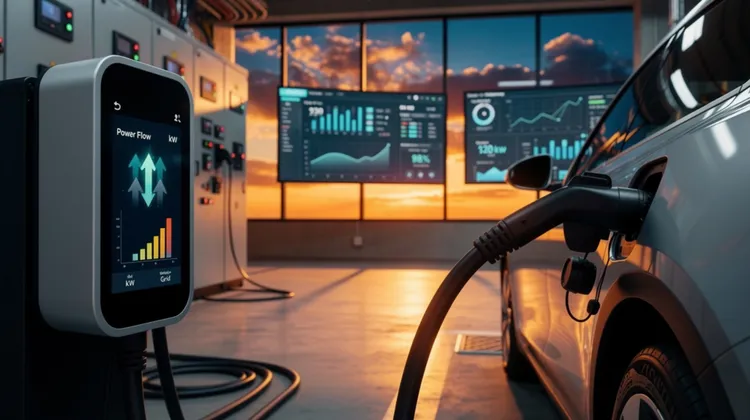
The global energy grid faces an escalating challenge: managing peak demand periods that strain infrastructure and drive up costs. As electric vehicle adoption accelerates, a transformative solution emerges—Vehicle-to-Grid (V2G) technology. By leveraging EV batteries as decentralized energy storage, V2G enables bidirectional power flow, allowing vehicles to discharge stored energy back to the grid during peak hours. This approach, known as peak shaving, reduces strain on substations, defers costly infrastructure upgrades, and offers economic benefits for both utilities and EV owners. However, widespread adoption hinges on overcoming technical hurdles, ensuring charger interoperability, and aligning financial incentives.
Peak shaving is not a new concept, but V2G introduces a paradigm shift. Traditionally, utilities rely on peaker plants—often natural gas-fired—that operate only during high demand. These plants are expensive, inefficient, and carbon-intensive. V2G offers a cleaner, more agile alternative. According to a 2023 study by the National Renewable Energy Laboratory, if just 10% of U.S. EVs participated in V2G programs, they could provide up to 30 gigawatts of peak capacity, equivalent to roughly 60 peaker plants. This statistic underscores the potential, but realizing it requires robust technical architecture.
Technical Requirements for V2G Integration
The backbone of V2G is bidirectional charging infrastructure. Unlike standard Level 2 chargers that only draw power, bidirectional chargers must support both grid-to-vehicle (G2V) and vehicle-to-grid (V2G) modes. This requires inverters capable of converting DC battery power to AC grid-compatible power and vice versa. The charger must also manage power quality, ensuring voltage and frequency stability during discharge.
Communication protocols are equally critical. The IEEE 2030.5 standard, often used for smart grid applications, enables secure data exchange between EVs, chargers, and utilities. This includes real-time signals for discharge commands, state of charge (SoC) reports, and pricing information. Without standardized protocols, interoperability fails, creating fragmented systems that utilities cannot reliably manage.
Another technical challenge is battery degradation. Cycling EV batteries for grid services can accelerate wear, though modern lithium-ion chemistries are resilient. A 2022 study in the Journal of Energy Storage found that V2G participation with moderate cycling (e.g., 10-20% depth of discharge) added only 3-5% capacity loss over 10 years—a manageable trade-off for grid benefits. Utilities must implement smart algorithms that prioritize lower-utilized batteries to minimize degradation.
Bidirectional Charger Interoperability
Interoperability is the linchpin of V2G scalability. Today, the market includes multiple charger manufacturers—ChargePoint, ABB, Wallbox, and others—each with proprietary software. Without universal standards, a Nissan Leaf might not communicate seamlessly with a Siemens charger connected to a Duke Energy grid management system. The Open Charge Point Protocol (OCPP) and ISO 15118 are emerging as key standards. ISO 15118, in particular, supports plug-and-charge and bidirectional communication, enabling automatic authentication and power flow negotiation.
Utilities must also integrate with aggregators. Aggregators pool thousands of EVs into virtual power plants (VPPs), managing discharge schedules to meet grid needs. For example, a utility may request 5 MW of power at 6 PM; the aggregator dispatches a subset of vehicles to discharge. This requires robust APIs and real-time telemetry. The California Independent System Operator (CAISO) has piloted such programs, demonstrating that aggregated V2G can provide frequency regulation and peak shaving simultaneously.
Economic Incentives for EV Owners and Utilities
Economic incentives drive adoption. For EV owners, V2G offers revenue streams through demand response programs. Utilities often pay participants per kilowatt-hour discharged or provide flat monthly credits. In the UK, the Vehicle-to-Grid Britain project reported average annual earnings of £350 per participant, with top performers earning over £800. These figures offset charging costs and battery degradation concerns.
Utilities benefit from deferred infrastructure investments. Building a new substation costs millions, while V2G programs require minimal capital—primarily charger subsidies and software integration. A 2024 analysis by the Rocky Mountain Institute found that V2G peak shaving could save U.S. utilities $2.5 billion annually in avoided peaker plant costs and transmission upgrades. Additionally, V2G reduces reliance on fossil fuels, aligning with decarbonization goals.
Time-of-use (TOU) rates further incentivize participation. By charging during off-peak hours (e.g., overnight) and discharging during peak periods, EV owners arbitrage energy prices. This requires smart charging algorithms that optimize based on real-time pricing. Some utilities also offer capacity payments for guaranteed availability, ensuring a fleet of vehicles is always ready to discharge.
Challenges and Real-World Deployments
Despite promise, challenges remain. Battery warranty concerns are a barrier; automakers like Tesla and Nissan limit V2G use to preserve battery health. However, newer models, such as the Ford F-150 Lightning and Hyundai Ioniq 5, support V2G with extended warranties. Regulatory frameworks are also evolving. In the U.S., FERC Order 2222 enables distributed energy resources, including V2G, to participate in wholesale markets, but state-level policies vary.
Real-world deployments demonstrate viability. The Nissan Leaf-to-home system in Japan, launched after the 2011 Fukushima disaster, provides backup power and peak shaving. In Denmark, the Parker Project integrated V2G with wind power, using EV batteries to smooth renewable intermittency. These projects prove technical feasibility, but scaling requires utility commitment and consumer education.
The Road Ahead
Integrating V2G for peak shaving is not a distant concept—it is a present-day opportunity. Technical requirements are being standardized, bidirectional chargers are becoming more affordable, and economic incentives are aligning. For infrastructure managers and energy professionals, the path forward involves investing in interoperable hardware, partnering with aggregators, and designing programs that reward participation. As EV adoption surges, V2G will transform EV batteries from mere transportation assets into critical grid resources, enhancing reliability and sustainability for decades to come.