
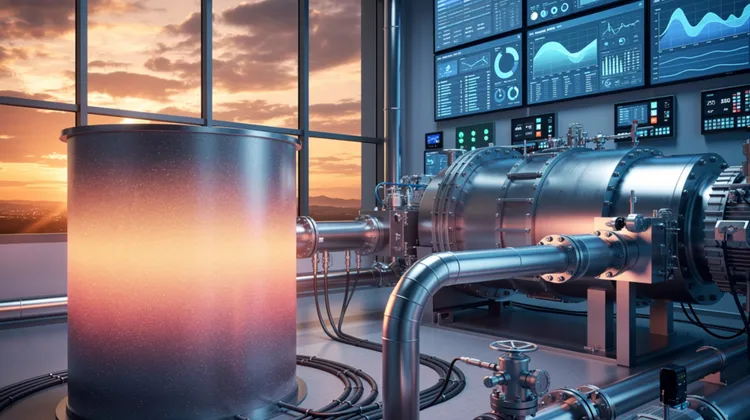
Industrial decarbonization is a complex puzzle; electrification alone won’t solve the heat problem. Heavy manufacturing, chemicals, and steelmaking require continuous, high‑temperature steam that most renewable sources can’t deliver directly. Thermal Energy Storage (TES) steps in as the bridge, converting excess solar or wind electricity into heat that can be released on demand. This article explores how molten salt and ceramic media are redefining the industrial energy landscape and driving the next wave of clean production.
Why Industrial Heat Is a Big Emission Driver
- 30% of global CO₂ originates from industrial processes that rely on high‑temperature heat.
- The steel sector alone emits around 3.5 Gt CO₂ annually, with 80% linked to furnace operation.
- Traditional fossil‑fuel boilers run continuously, making it hard to shift away from carbon‑intensive fuels.
Because renewables are intermittent, the key challenge is to store the surplus power produced when supply exceeds demand and deliver it as thermal energy when production peaks.
Thermal Energy Storage: The Missing Piece
TES captures and stores excess renewable electricity as heat in a medium that can be released later. Two main media dominate the field:
| Medium | Typical Temperature Range | Storage Mechanism | Key Applications |
|---|---|---|---|
| Molten Salts | 300–600 °C | Phase‑change or sensible heat | Power plants, industrial steam |
| Ceramic Media | 600–1000 °C | Sensible heat | Chemical reactors, metal smelting |
Both media can store energy in kilowatt‑hours or megawatt‑hours, providing flexibility to match production schedules.
How TES Works
- Capture – Renewable generators (solar PV, wind turbines) feed electricity into a TES unit during off‑peak or surplus periods.
- Heat Conversion – An electric heater transfers the electrical energy into the storage medium, raising its temperature.
- Storage – The heat is retained in insulated tanks or packed beds, maintaining temperature for hours or days.
- Release – When industrial demand spikes, the stored heat is transferred via heat exchangers to steam boilers or process heaters.
The result is a decoupling of electricity supply from heat demand, enabling continuous, low‑carbon operation.
TES Technologies in Focus
Molten Salt TES
- Advantages: High thermal conductivity, low viscosity, minimal phase change losses.
- Typical Setup: A double‑tank system where a lower tank stores the molten salt and an upper tank circulates it through heat exchangers.
- Applications: Solar thermal power plants, combined heat and power (CHP) units, steelmaking furnaces.
Ceramic Medium TES
- Advantages: Extremely high maximum temperatures, excellent mechanical strength, long thermal cycle life.
- Typical Setup: Porous ceramic bricks or monoliths packed in a tank, heated by electric coils or waste heat.
- Applications: Chemical reactors requiring >900 °C, smelting of refractory metals, advanced manufacturing processes.
Key Advantages Across Both Media
- Grid Balancing – Absorbs excess renewable generation, reducing curtailment.
- High‑Temperature Steam – Delivers steam at or above 500 °C, matching industrial boiler needs.
- Cost Efficiency – Long service life and