
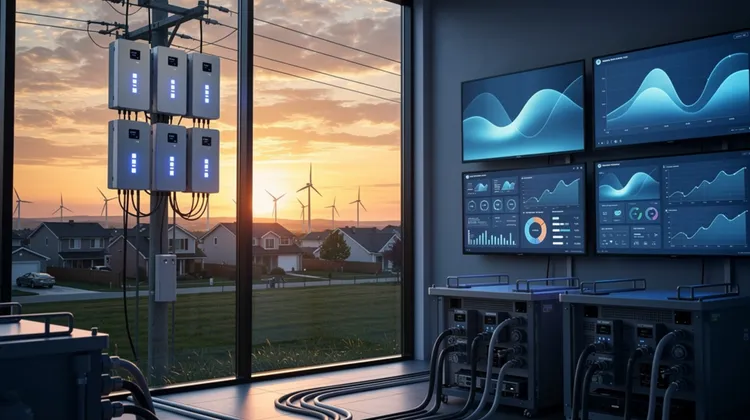
Virtual Power Plants (VPPs) have emerged as a transformative solution for modern grids, turning a patchwork of small‑scale energy resources into a single, coherent power plant. By aggregating thousands of distributed energy resources (DERs) such as residential batteries, smart thermostats, and commercial solar arrays, VPPs provide reliable grid services like frequency regulation, voltage support, and load balancing. This capability not only stabilizes the grid but also unlocks new revenue streams for asset owners and operators.
How VPPs Work: The Basics
A VPP is essentially a sophisticated software platform that orchestrates the operation of many disparate DERs. The core components are:
- Data Acquisition – Real‑time telemetry from each DER (battery state of charge, solar irradiance, thermostat setpoints).
- Control Algorithms – Optimization models that decide how much power each resource should generate or consume to meet grid objectives.
- Communication Layer – Secure, low‑latency channels (often using IEC 61850 or MQTT) that transmit commands and status updates.
- Market Interface – Integration with energy markets and grid operator dispatch signals to monetize services.
When a VPP receives a frequency regulation request, for example, it quickly calculates the aggregate response required and dispatches individual DERs accordingly. The result is a rapid, coordinated adjustment that mimics the behavior of a conventional power plant.
Key Benefits for Grid Reliability
| Benefit | Explanation | Impact |
|---|---|---|
| Rapid Response | DERs can change output in seconds, far faster than conventional plants. | Improves frequency stability and reduces outage risk. |
| Scalability | Adding more DERs simply expands capacity; no new infrastructure needed. | Lowers capital expenditure while increasing system resilience. |
| Distributed Resilience | Localized generation reduces dependence on distant power plants. | Enhances protection against long‑haul transmission failures. |
| Demand‑Side Flexibility | Thermostats and HVAC systems can shift usage patterns. | Lowers peak demand, deferring costly grid upgrades. |
Recent studies show that a VPP of 1 GW can provide up to 20 % of the frequency regulation demand in a large U.S. state, illustrating the scale of potential impact.
Typical DERs in a VPP
- Residential Batteries – Tesla Powerwalls, LG Chem RESU, SonnenBatterie.
- Commercial Energy Storage – Enphase EnergyVault, Generac Pulse.
- Solar Photovoltaic (PV) – Rooftop arrays, community solar farms.
- Thermostats & HVAC – Nest, Ecobee, Siemens Desigo.
- Electric Vehicles (EVs) – Plug‑in hybrids, battery electric vehicles with vehicle‑to‑grid (V2G) capability.
Each type contributes differently: batteries provide instant power, PV offers clean generation, and thermostats deliver load‑shifting flexibility. The VPP’s optimization engine balances these inputs to meet target outputs while respecting individual device constraints.
Market Participation and Revenue Streams
VPPs can monetize several grid services:
- Ancillary Services – Frequency and voltage regulation, spinning reserve.
- Capacity Markets – Provision of peak power capacity to the grid operator.
- Demand Response – Curtailment of load during high‑price periods.
- Energy Arbitrage – Buying low, selling high across time zones or markets.
Because the VPP aggregates many small assets, it can qualify for market participation thresholds that would be impossible for a single homeowner or business. This democratizes energy markets, allowing community owners to earn revenue from their existing equipment.
Technology Enablers
- Edge Computing – Local processors near DERs reduce latency, enabling instant response.
- AI & Machine Learning – Predictive models forecast solar output, battery degradation, and occupant behavior.
- Blockchain – Secure, tamper‑proof transaction records for energy credits.
- Advanced Sensors – Smart inverters, power meters, and weather stations provide high‑resolution data.
These tools collectively ensure that the VPP operates reliably, efficiently, and securely.
Regulatory and Policy Landscape
Governments worldwide are creating frameworks to support DER aggregation. In the U.S., the Federal Energy Regulatory Commission (FERC) Order 841 encourages the participation of DERs in ancillary services markets. European directives, such as the European Green Deal, also promote virtual power plant deployment. Key policy levers include:
- Net Metering Reforms – Allowing aggregated surplus to be credited to a common account.
- Market Access Rules – Simplifying bids for small‑scale resources.
- Cybersecurity Standards – Ensuring communication integrity and data privacy.
Stakeholders must stay abreast of evolving regulations to fully capitalize on VPP opportunities.
Challenges and Mitigation Strategies
| Challenge | Mitigation |
|---|---|
| Cybersecurity Risks | Zero‑trust architecture, regular penetration testing, encryption of control signals. |
| Data Quality Issues | Standardized telemetry protocols, redundancy in data paths. |
| Asset Heterogeneity | Modular control interfaces, common API layers. |
| Grid Integration Complexity | Pilot projects, simulation-based validation, close collaboration with grid operators. |
Addressing these challenges early ensures smooth deployment and long‑term viability.
Real‑World Success Stories
- California Power Exchange (CalPX) – Operated a 200 MW VPP that delivered frequency regulation during the 2021 California blackout, reducing the impact on consumers.
- London’s Smart Grid Initiative – Integrated 30,000 residential batteries into a city‑wide VPP, cutting peak demand by 5 % in the summer of 2023.
- Australia’s Renewable Integration – A VPP combining solar PV, batteries, and EVs in the Queensland grid supplied 10 % of the state’s ancillary services, supporting the penetration of 50 % renewable electricity.
These examples demonstrate the tangible benefits of VPPs across different markets and grid conditions.
Future Outlook
The trajectory for VPPs is one of rapid growth, driven by:
- Increasing DER Adoption – More households are installing solar and battery systems.
- Grid Modernization – Smart grid infrastructure expands, facilitating remote control.
- Policy Momentum – Governments are incentivizing distributed generation and resilience.
- Technological Advances – AI, edge computing, and secure communication protocols mature.
By 2030, projections estimate that VPPs could aggregate up to 25 GW of distributed capacity worldwide, providing a significant share of the grid’s ancillary services.