
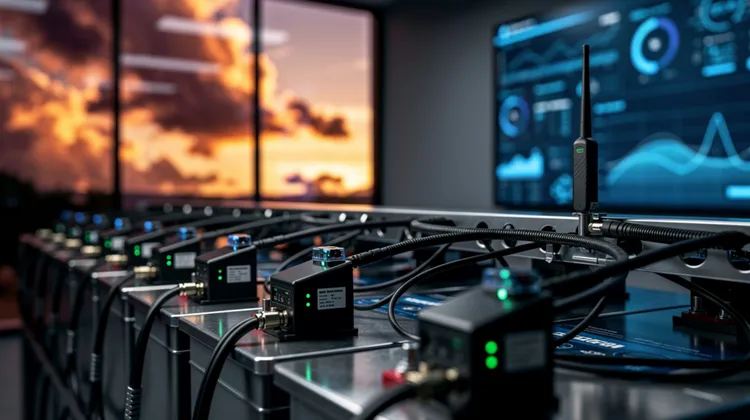
In the world of critical infrastructure, backup power is the last line of defense against downtime. But batteries, the heart of any uninterruptible power supply (UPS) system, are notoriously unpredictable. A battery that tests fine today can fail catastrophically tomorrow—especially when temperature spikes or internal resistance climbs unnoticed. This is where IoT sensors step in, transforming battery health monitoring from a reactive guess into a precise, data-driven science.
For decades, facility managers relied on periodic manual checks—voltage readings, specific gravity tests, and visual inspections. These methods, while better than nothing, are inherently flawed. They capture only a snapshot in time, missing the subtle degradation that occurs between inspections. IoT sensors change this equation entirely. By embedding low-cost, wireless sensors directly onto battery terminals or integrating them into battery management systems, operators gain continuous, real-time visibility into two critical parameters: impedance and temperature.
Why Impedance Matters
Impedance, or internal resistance, is the single most reliable indicator of battery health. As a battery ages or suffers from sulfation, corrosion, or dryout, its internal resistance rises. This increase directly reduces the battery’s ability to deliver high current during a power outage. IoT sensors measure impedance at the cell level, often using a technique called electrochemical impedance spectroscopy (EIS). These sensors can detect a 10% increase in impedance long before a traditional voltage check would flag an issue.
Consider a data center with hundreds of VRLA batteries. A single battery with elevated impedance can drag down the entire string’s performance. Studies from the Electric Power Research Institute (EPRI) show that over 60% of UPS battery failures are preceded by a gradual rise in impedance, yet most facilities only catch this during annual load tests—often too late. IoT sensors provide daily, even hourly, impedance data, allowing predictive maintenance teams to replace weak cells before they cause a string failure.
Temperature: The Silent Killer
Temperature is the other half of the equation. Every 10°C rise above 25°C halves a battery’s design life, according to IEEE standards. Yet many battery rooms have uneven cooling, creating hot spots that accelerate degradation in specific cells. IoT temperature sensors, placed on individual battery terminals or inside battery cabinets, provide granular thermal profiles. When a sensor detects a deviation of more than 2°C from the string average, it triggers an alert. This early warning allows operators to adjust airflow, identify failing chargers, or replace a cell that is beginning to thermally run away.
A real-world example: A major telecommunications provider deployed IoT temperature sensors across its 2,000+ remote cell sites. Within the first month, the system identified 47 batteries operating above safe thresholds due to faulty HVAC units. The average temperature reduction after repairs was 8°C, extending battery life by an estimated 18 months and preventing at least 12 potential outages.
Integration with Existing Systems
The beauty of IoT sensors is their compatibility. Most modern sensors use wireless protocols like LoRaWAN, Zigbee, or Bluetooth Low Energy, allowing them to communicate with existing building management systems (BMS) or cloud-based monitoring platforms. Data flows into a dashboard where operators can view impedance trends, temperature heatmaps, and predicted remaining useful life (RUL) for each battery. Alerts can be sent via email, SMS, or integrated into SCADA systems.
This integration eliminates the need for manual data logging and reduces human error. A 2023 survey by Uptime Institute found that 40% of data center outages were caused by human error, with battery-related mistakes accounting for a significant portion. IoT automation removes the guesswork.
Cost and ROI
Deploying IoT sensors is not free, but the return on investment is compelling. A single battery replacement in a large UPS system can cost thousands of dollars in parts and labor, not including the cost of downtime. For a hospital or financial institution, a 10-minute outage can cost millions. IoT sensor systems, priced at $20–$50 per sensor, pay for themselves after preventing just one failure. Moreover, by extending battery life through proactive temperature management, organizations can defer capital expenditures on battery replacements by 12–24 months.
Challenges and Considerations
No technology is without caveats. IoT sensors require a reliable network infrastructure, and battery rooms are often Faraday cages that can block wireless signals. Proper antenna placement or wired alternatives may be necessary. Additionally, the data generated is only useful if acted upon. Organizations must have a maintenance workflow in place to respond to alerts. Finally, sensor calibration and battery chemistry compatibility—especially for lithium-ion systems—must be verified.
The Bottom Line
IoT sensors are not a luxury—they are becoming a standard requirement for any facility that depends on backup power. The ability to monitor impedance and temperature in real time, combined with predictive analytics, turns battery management from a reactive chore into a proactive strategy. For uptime warriors, the message is clear: if you are not monitoring your batteries with IoT sensors, you are flying blind.