
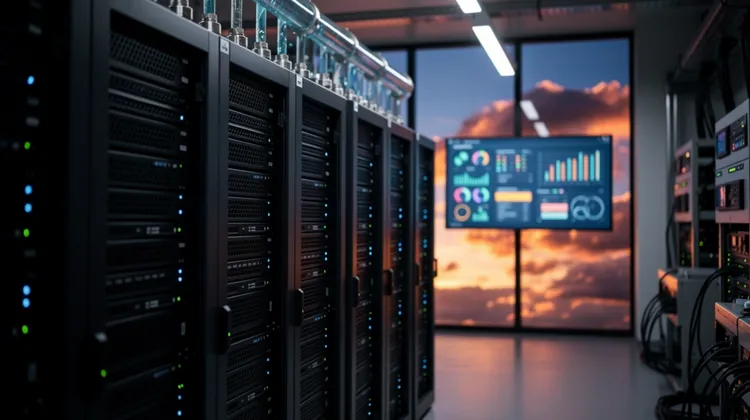
The era of the AI data center is not a gradual evolution; it is a step change in how we consume electricity. For decades, data center energy planning revolved around predictable, incremental growth. Server densities were relatively stable, and power usage effectiveness (PUE) was the primary metric of success. That world has ended. The rapid deployment of graphics processing units (GPUs) and specialized accelerators for artificial intelligence has shattered previous assumptions about power density, cooling requirements, and grid interaction. Hyperscale operators are now confronting a reality where a single AI training cluster can draw more power than a small town, and where the variability of that load poses unprecedented challenges to both facility design and the broader electrical grid.
The shift is not merely about consuming more megawatts. It is about how those megawatts are planned, procured, and managed. Traditional capacity planning, which relied on static power ratings and conservative utilization rates, is being replaced by models that must account for the spiky, compute-intensive nature of AI training and inference. The result is a fundamental rethinking of the relationship between the data center and the energy ecosystem around it.
The Density Problem: From Kilowatts to Megawatts per Rack
The most immediate impact of AI workloads is on rack-level power density. A typical pre-AI data center rack might have consumed between 5 and 10 kilowatts. Today, high-performance GPU racks for AI training can demand 40, 80, or even over 100 kilowatts per rack. This is not a marginal increase; it is an order-of-magnitude shift that breaks the physical and electrical design assumptions of most existing facilities.
This density explosion has several cascading effects. First, the electrical distribution infrastructure within the building must be overhauled. Standard power distribution units and cabling are insufficient for the amperage required by modern AI servers. Operators are increasingly moving to higher voltage distribution, such as 415V or even 800V DC, to reduce losses and copper requirements. Second, the physical floor space becomes less of a constraint than the power delivery path. The critical path is no longer how many racks you can fit in a hall, but how much power you can deliver to a given footprint.
The planning implications are significant. Hyperscale operators can no longer sign a lease for a shell building and fit it out with standard equipment. They must work backward from the power density of the intended AI hardware, designing the electrical room, busway, and rack power supplies in tandem. This has led to a surge in demand for colocation facilities that offer high-density zones, often with liquid cooling pre-installed, as standard configurations.
The Cooling Conundrum: Air Is No Longer Enough
The heat generated by AI accelerators is the direct physical consequence of their energy consumption. A GPU running a training workload can generate more heat per square inch than a traditional central processing unit (CPU) by a factor of three to five. The traditional method of cooling data centers—computer room air handlers (CRAHs) blowing cold air through a raised floor—is simply not capable of removing heat at the rate required for high-density AI racks.
This has forced a rapid migration toward liquid cooling technologies. Direct-to-chip cooling, where a cooled liquid is circulated through a cold plate attached directly to the processor, is becoming the standard for new AI infrastructure. Some operators are also exploring immersion cooling, where entire servers are submerged in a dielectric fluid. The energy planning implications are twofold. First, the data center’s own power consumption for cooling decreases, as liquid is far more efficient at heat transfer than air. Second, the facility’s water or closed-loop cooling system becomes a critical piece of infrastructure, requiring its own redundancy and monitoring.
From an energy planning perspective, the move to liquid cooling changes the calculation of PUE. While a well-designed liquid-cooled facility can achieve a PUE of 1.1 or lower, the operational complexity is higher. The planning team must now consider the energy required to pump the coolant, the capacity of the heat rejection equipment (such as cooling towers or dry coolers), and the resilience of the entire thermal loop. The failure mode is no longer a hot aisle; it is a potential system-wide shutdown if the liquid loop is compromised.
Grid Interdependence and the New Demand Curve
Perhaps the most profound shift in energy planning is the changing relationship between the data center and the external power grid. Historically, data centers were viewed as large but relatively stable loads. They ran 24/7 with a predictable power draw. AI workloads, however, introduce significant volatility. Training jobs can ramp up power consumption from near-idle to maximum in a matter of minutes. Inference workloads, which serve user requests, are inherently bursty and unpredictable.
This variability is problematic for grid operators who are already managing the intermittency of renewable energy sources. A hyperscale data center that suddenly draws 200 megawatts more power for a training run can cause frequency fluctuations and voltage instability on a local grid. As a result, energy planning is moving beyond simply securing a power purchase agreement (PPA). It now involves active collaboration with utility companies to ensure grid stability.
In response, we are seeing the emergence of "grid-interactive" data centers. These facilities are designed to modulate their power consumption in response to grid signals. For example, an AI training job might be paused or slowed during a peak demand event, or a data center might use its on-site battery storage to provide frequency regulation services back to the grid. This requires a sophisticated energy management system that can balance the compute workload with the external power market conditions. The data center is no longer just a consumer; it is becoming a distributed energy resource.
The Rise of On-Site Generation and Long-Duration Storage
The uncertainty around grid capacity and the long lead times for new transmission lines are pushing hyperscale operators to consider on-site energy generation more seriously than ever before. While solar and wind are popular for their low carbon footprint, they are intermittent. To pair them with the 24/7 demands of AI, operators are investing in long-duration energy storage (LDES) solutions. These are not the lithium-ion batteries used for short-term UPS backup, but technologies like iron-air batteries, compressed air energy storage, or green hydrogen fuel cells that can provide power for 10 to 100 hours.
The energy planning model is shifting from "buy power from the grid" to "manage a local microgrid." A hyperscale campus might have a 500-megawatt solar farm, a 100-megawatt battery storage facility, and a gas turbine or fuel cell plant for firm power. The data center’s control system must then intelligently dispatch these resources to minimize cost and carbon while maximizing uptime. This is a level of complexity that was previously the domain of utility engineers, not data center facility managers.
However, this approach is not without its challenges. On-site generation requires significant capital expenditure and expertise in power engineering. It also introduces new failure modes. A data center that is reliant on a microgrid must have the same level of redundancy for its generators and storage systems as it does for its servers. The risk profile is different, but the goal remains the same: absolute reliability.
Software-Defined Power: The New Frontier
The final piece of the puzzle is the software layer. Energy planning is no longer a static exercise done at the design stage. It is a dynamic, real-time operation. Software-defined power (SDP) is an emerging concept where the data center’s power infrastructure is managed as a single, programmable entity. This software can monitor the power draw of every server, predict the energy needs of upcoming workloads, and dynamically adjust the power delivery and cooling to optimize for efficiency or reliability.
For AI workloads, this is particularly powerful. The software can schedule training jobs to run during periods of low electricity prices or high renewable energy availability. It can also throttle GPU performance slightly to stay within a power cap, avoiding the need to provision for the absolute worst-case scenario. This "power capping" strategy can reduce the required infrastructure capacity by 10-20%, which translates to millions of dollars in avoided capital expenditure.
Furthermore, SDP enables a more granular approach to redundancy. Instead of having a full N+1 UPS system for the entire facility, the software can ensure that only the most critical workloads have guaranteed power, while less critical tasks can be gracefully degraded during a grid event. This is a fundamental shift from a "one size fits all" approach to power reliability, to a tiered model based on application criticality.
A New Paradigm for a New Era
The energy planning strategies that served the data center industry for the past two decades are obsolete. The arrival of AI has forced a re-evaluation of every assumption, from the size of the electrical feed to the method of heat removal. The hyperscale data centers of the future will not simply be larger versions of today’s facilities; they will be fundamentally different machines, designed to manage extreme power density, interact dynamically with the grid, and operate as self-contained energy ecosystems.
For the operators, engineers, and planners in this space, the challenge is immense. It requires a blend of skills that were previously siloed: electrical engineering, thermal management, software development, and energy market trading. But the reward is equally significant. Those who can master this new paradigm will not only power the AI revolution but will also set the standard for how critical infrastructure interacts with the energy landscape for decades to come. The path forward is complex, but the direction is clear: energy planning for AI data centers is now a core engineering discipline, not an afterthought.