
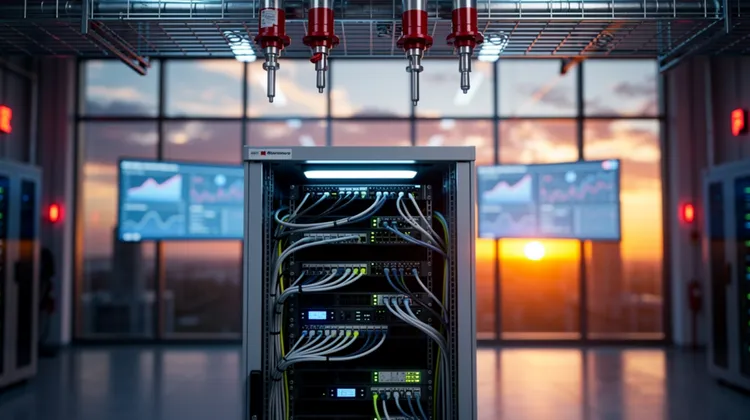
On March 10, 2021, a fire erupted at the OVHCloud data center in Strasbourg, France, destroying one of the facility's four buildings (SBG2) and severely damaging another (SBG1). The blaze sent shockwaves through the global IT community, taking down millions of websites, including government portals, banking systems, and e-commerce platforms. While the immediate cause was traced to an electrical fault in an uninterruptible power supply (UPS) system, the deeper lesson was about backup risks. The OVHCloud fire exposed how even the most redundant infrastructure can fail when backup systems are not truly independent.
The Anatomy of the Disaster
The fire started around 12:47 AM local time in a UPS unit. Despite the presence of fire suppression systems, the flames spread rapidly due to the high density of electrical equipment and the limited effectiveness of gas-based suppression in open-floor data centers. By the time firefighters arrived, SBG2 was fully engulfed. The incident forced OVHCloud to declare a major outage, affecting over 3.6 million domains and countless business operations.
What made this fire particularly instructive was the failure of backup power and cooling systems. Many clients had assumed that their redundant configurations—multiple power feeds, backup generators, and cooling loops—would protect them. But when the fire destroyed the primary power distribution and the backup systems were housed in the same building or shared the same electrical path, the redundancy was meaningless.
Backup Risks: The Hidden Vulnerability
The OVHCloud fire highlighted a critical flaw in how many organizations design their backup infrastructure. Redundancy is not just about having spare equipment; it is about ensuring that those backups are physically and logically isolated from the primary systems. In the Strasbourg facility, backup generators and UPS units were located in the same building as the primary power systems. When the fire spread, it took out both the primary and backup power sources simultaneously.
This is a common problem across the industry. According to a 2022 Uptime Institute survey, 42% of data center operators reported that their backup power systems were not fully independent from the primary infrastructure. The OVHCloud fire served as a stark reminder that true resilience requires geographic separation, diverse power feeds, and independent cooling loops.
Changes in Data Center Fire Safety Since 2021
In the wake of the OVHCloud fire, several significant changes have reshaped data center fire safety and redundancy planning:
1. Redesigned Fire Suppression Systems
Many operators have moved away from relying solely on gas-based suppression (such as FM-200 or Novec 1230) for open-floor layouts. Instead, they are integrating early-warning systems like VESDA (Very Early Smoke Detection Apparatus) and deploying compartmentalized fire zones that can isolate a fire before it spreads. Some facilities are also installing water mist systems as a backup to gas suppression, despite the risk of water damage.
2. Independent Backup Power and Cooling
The most direct lesson from OVHCloud is the need for true independence. Data centers are now designing backup power and cooling systems that are located in separate buildings or at least in separate fire-rated compartments. For example, some hyperscale operators are building backup generators on the opposite side of the campus, with dedicated fuel lines and electrical conduits that do not cross the primary infrastructure.
3. Enhanced Uptime Monitoring
Real-time monitoring of environmental conditions—temperature, humidity, smoke, and electrical load—has become more granular. Operators are deploying IoT sensors at the rack level to detect anomalies before they escalate. Uptime monitoring platforms now integrate fire detection data with power and cooling metrics, providing a holistic view of facility health.
4. Stricter Fire Testing and Drills
The OVHCloud fire exposed gaps in emergency response protocols. Many data centers have since implemented quarterly fire drills that simulate real-world scenarios, including simultaneous failures of primary and backup systems. These drills test not only the fire suppression equipment but also the manual override procedures and communication chains.
Industry-Wide Impact on Infrastructure Reliability
The OVHCloud fire was a catalyst for broader changes in how the industry thinks about infrastructure reliability. The incident prompted a re-evaluation of risk assessment methodologies, particularly for colocation providers. Clients now demand detailed documentation of physical separation between primary and backup systems. Service-level agreements (SLAs) have become more stringent, with penalties for outages caused by shared infrastructure.
According to a 2023 report by the Uptime Institute, the average cost of a data center outage has risen to $1.1 million, up from $740,000 in 2020. This financial pressure is driving investment in fire-resistant construction materials, redundant fire suppression systems, and independent power feeds. The OVHCloud fire also accelerated the adoption of modular data center designs, where individual pods are fire-rated and self-contained, limiting the blast radius of any single incident.
Lessons for Critical Infrastructure Beyond Data Centers
The lessons from OVHCloud extend beyond the data center industry. Any facility that relies on backup systems—whether in healthcare, energy, or manufacturing—must ensure that those backups are truly independent. In a hospital, for instance, backup generators should be located in a separate building or at least in a fire-rated enclosure that is not connected to the primary power room. In a power substation, redundant transformers should be on separate foundations with independent cooling systems.
The principle is simple: redundancy is only as good as the isolation between systems. If a single event—a fire, a flood, or a power surge—can take out both the primary and the backup, then the backup is not a backup at all.