
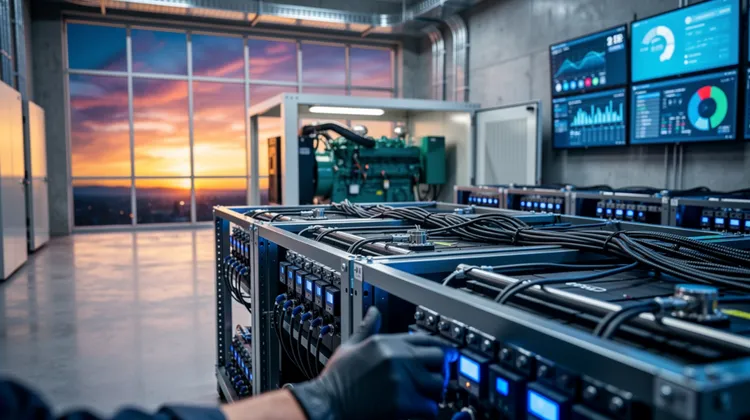
The relationship between electricity and uptime has never been more direct. For decades, IT teams focused on hardware failures, software bugs, and network outages as the primary threats to availability. But a new, more fundamental vulnerability is emerging: the power grid itself. When the lights go out, so do the servers, the cloud services, and the industrial control systems that modern society depends on. Power grid failures are now a leading cause of digital downtime, forcing data centers and technology providers to rethink their energy strategies from the ground up.
The numbers are stark. According to the U.S. Energy Information Administration, the average American electricity customer experienced over seven hours of power interruptions in 2021, the highest figure in over a decade. Major grid disturbances, from winter storms in Texas to heatwaves in California and cyberattacks on substations, are becoming more frequent and severe. For a hyperscale data center operating at 50 megawatts, even a few minutes of outage can mean millions of dollars in lost revenue, not to mention the reputational damage.
The Cascading Effect of Grid Instability
A power outage in a data center is not just about lost compute cycles. It triggers a cascade of failures. When the grid drops, Uninterruptible Power Supply (UPS) systems kick in, but they only provide minutes of backup. If generators fail to start—and they do fail, more often than operators admit—the entire facility goes dark. Servers crash, storage arrays corrupt, and network links drop. Recovery can take hours or days, depending on the damage.
For industries like healthcare, finance, and manufacturing, the consequences are immediate. A hospital's electronic health records go offline. A factory's programmable logic controllers stop. A trading firm's algorithms go silent. The digital economy runs on electricity, and when that flow stops, everything stops.
The New Resilience Playbook
Data center operators are not waiting for utilities to fix the grid. They are building their own resilience. The playbook includes three key strategies: on-site generation, advanced storage, and microgrid architecture.
On-Site Generation
Diesel generators have been the standard for decades, but they are noisy, polluting, and require frequent testing. Many operators are now adding natural gas turbines or fuel cells for cleaner, more reliable backup. Some hyperscalers like Google and Microsoft are even integrating small modular nuclear reactors into their long-term plans.
Battery Storage at Scale
Lithium-ion battery systems have become cost-competitive for short-duration backup. Tesla's Megapack and similar systems can provide 30 minutes to four hours of full-load power, bridging the gap between grid failure and generator startup. In some cases, batteries are replacing generators entirely for facilities with lower power demands.
Microgrid Architecture
The most advanced approach is the microgrid: a self-contained energy system that can disconnect from the main grid and operate independently. Microgrids combine solar panels, battery storage, generators, and sophisticated control software. They allow data centers to "island" themselves during grid disturbances, maintaining uptime while the surrounding community goes dark.
The Cost of Resilience
Building this level of energy resilience is expensive. A typical microgrid for a 10-megawatt data center can cost $10 million to $30 million upfront. But for companies where downtime costs $100,000 per minute or more, the math works. The question is no longer if operators can afford to invest, but if they can afford not to.
Smaller colocation facilities face a harder challenge. They lack the capital for on-site generation and the bargaining power for long-term power purchase agreements. Many are turning to "green tariff" programs from utilities, which guarantee renewable energy supply and grid stability for a premium. Others are colocating near large hydroelectric or nuclear plants, where grid reliability is higher.
The Role of Software and AI
Hardware is only half the solution. Software-defined power management is emerging as a critical tool. AI algorithms can predict grid instability hours in advance by analyzing weather data, utility alerts, and historical outage patterns. When a risk is detected, the software can preemptively shift workloads to other data centers, throttle non-critical processes, or charge batteries to full capacity.
This predictive approach reduces reliance on reactive backup systems. Instead of waiting for the grid to fail, operators can act before it does. Google's "carbon-intelligent computing" platform, for example, shifts flexible workloads to times when grid power is cleanest and most reliable, reducing both emissions and risk.
Regulatory and Insurance Pressure
Regulators are taking notice. In the European Union, the Network and Information Systems (NIS2) directive now requires critical infrastructure operators, including data centers, to demonstrate resilience against power outages. In the United States, the Federal Energy Regulatory Commission (FERC) is pushing for stricter reliability standards for grid-connected facilities.
Insurance companies are also tightening requirements. Policies for data centers now often mandate minimum backup power durations, regular generator testing, and documented microgrid capabilities. Premiums for facilities without robust energy resilience are rising fast.
A Glimpse at the Future
The grid of the future will not be a one-way pipe from power plant to consumer. It will be a dynamic, distributed network where data centers act as both consumers and providers of energy. Facilities with large battery banks can sell power back to the grid during peak demand, earning revenue while improving grid stability. This "grid-interactive" model is already being tested in California and New York.
For uptime warriors, the message is clear: power resilience is no longer a secondary concern. It is the foundation on which all digital reliability rests. The data centers and tech providers that invest in microgrids, battery storage, and predictive software today will be the ones that stay online tomorrow—no matter what the grid does.