
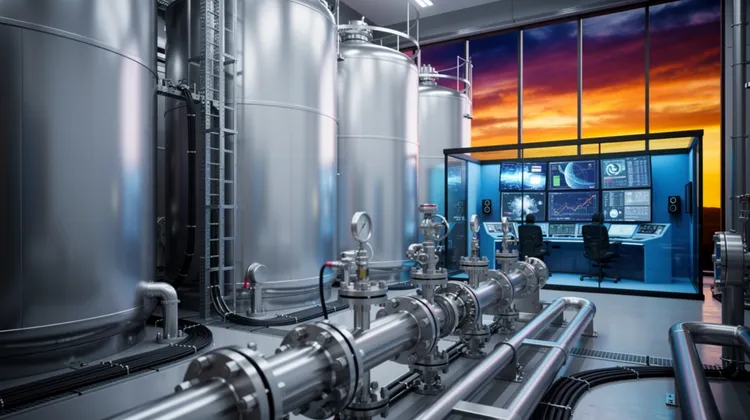
Industrial heat accounts for roughly one-fifth of global energy demand, making it one of the most stubborn sectors to decarbonize. Unlike electricity generation, where solar and wind can directly feed the grid, factories need consistent, high-temperature heat often around the clock. This is where thermal energy storage (TES) systems using molten salts or phase-change materials are emerging as a game-changing bridge. By storing renewable energy as heat and releasing it on demand, TES allows industrial facilities to operate on clean power even when the sun isn’t shining or the wind isn’t blowing.
The challenge is scale. While thermal storage has been used for decades in concentrated solar power plants, adapting these technologies for industrial process heat requires rethinking materials, system integration, and economics. Recent breakthroughs, however, are pushing TES into the mainstream of industrial decarbonization.
Why Thermal Storage Matters for Industry
The industrial sector is uniquely difficult to electrify directly. Processes like cement kilns, steel furnaces, and chemical reactors require temperatures from 300°C to over 1,500°C. Lithium-ion batteries, while excellent for grid storage, are not cost-effective for delivering high-temperature heat at the gigawatt-hour scale. Thermal energy storage fills this gap by capturing excess renewable electricity and converting it into thermal energy that can be held for hours or even days.
Key advantages of TES for industrial applications include:
- Cost efficiency: Molten salt systems can store energy at $20–$50 per kilowatt-hour of thermal capacity, significantly cheaper than battery storage at $100–$150 per kWh.
- High-temperature capability: Advanced molten salt mixtures can operate above 700°C, meeting the needs of many industrial processes.
- Long duration: TES systems can discharge for 6–12 hours or longer, matching industrial shift schedules.
- Grid flexibility: Factories can shift their energy consumption to times when renewable electricity is abundant and cheap, reducing operational costs.
Molten Salt Storage: The Proven Workhorse
Molten salt thermal storage is the most mature technology for industrial-scale applications. Current systems typically use a mixture of sodium nitrate and potassium nitrate, which melts at around 220°C and remains stable up to 600°C. The principle is straightforward: excess electricity heats the salt through resistive heaters, the hot salt is stored in insulated tanks, and when heat is needed, it is pumped through a heat exchanger to generate steam or hot air for industrial processes.
Recent developments are expanding the temperature range. Researchers at the German Aerospace Center (DLR) have demonstrated molten salt mixtures based on calcium nitrate and lithium nitrate that can operate above 700°C. This opens up applications in the steel and glass industries, where ultra-high temperatures are non-negotiable.
The economics are improving rapidly. A 2024 study by the International Renewable Energy Agency (IRENA) found that levelized cost of heat from molten salt storage has fallen by 40% since 2019, driven by larger tank sizes and improved insulation materials. For a typical chemical plant requiring 10 MW of process heat, a molten salt TES system can reduce carbon emissions by 60–80% compared to natural gas boilers.
Phase-Change Materials: The Next Frontier
While molten salt storage is effective, it requires large insulated tanks and significant space. Phase-change materials (PCMs) offer a more compact alternative by storing energy during the transition from solid to liquid, absorbing large amounts of latent heat at a constant temperature.
Common PCMs include paraffin waxes, salt hydrates, and metallic alloys. For industrial use, salt-based PCMs such as sodium chloride or magnesium chloride are promising because they can store heat at temperatures from 300°C to 800°C with high energy density. A PCM system can store up to three times more energy per cubic meter than a molten salt system at the same temperature range.
Startups like Malta (a spin-off from X) and Rondo Energy are commercializing PCM-based thermal batteries that use graphite blocks or ceramic bricks as storage media. These systems can charge from renewable electricity and discharge heat at temperatures exceeding 1,000°C, making them suitable for cement and steel production. Rondo’s "Heat Battery" uses refractory bricks heated to 1,500°C by electric resistance heaters, with heat extracted via air or steam. The company claims its system can reduce industrial carbon emissions by 90% compared to fossil fuel boilers.
Integration Challenges and Solutions
Scaling TES for industrial decarbonization is not without technical hurdles. Key challenges include:
- Material corrosion: Molten salts are highly corrosive at high temperatures, requiring expensive nickel-based alloys for tanks and piping.
- Thermal cycling: Repeated heating and cooling can cause fatigue in storage materials, reducing lifespan.
- Heat transfer efficiency: Getting heat into and out of the storage medium efficiently requires advanced heat exchanger designs.
- System integration: Retrofitting TES into existing industrial plants requires careful engineering to match temperature profiles and process schedules.
Solutions are emerging. Advanced coatings and ceramic linings are reducing corrosion rates by 50–70% in pilot projects. New heat exchanger designs using additive manufacturing allow for complex geometries that improve heat transfer by 30%. And digital twin software is helping plant operators optimize charging and discharging cycles to maximize system lifetime.
Market Momentum and Real-World Deployments
The thermal energy storage market for industrial applications is projected to grow from $4.5 billion in 2024 to $12.8 billion by 2030, according to a report by Bloomberg NEF. Major industrial players are already investing:
- BASF is building a 10 MW molten salt TES system at its Ludwigshafen chemical complex in Germany, expected to reduce natural gas consumption by 15%.
- ArcelorMittal is piloting a PCM-based system from Rondo Energy at its steel plant in Ghent, Belgium, targeting a 20% reduction in coal use.
- Cemex has partnered with Synhelion to develop solar thermal storage for cement production, using a combination of molten salt and ceramic particles to reach 1,500°C.
These projects demonstrate that TES is moving from laboratory to factory floor. The key enabler is falling renewable electricity prices, which make it economically viable to store and reuse clean energy rather than burning fossil fuels.
The Path Forward
Thermal energy storage is not a silver bullet for industrial decarbonization, but it is an essential piece of the puzzle. For industries that cannot electrify directly or use hydrogen affordably, TES provides a practical, scalable solution using existing infrastructure. The next five years will see significant deployments as costs continue to fall and material science improves.
As more factories integrate TES systems, the industrial sector can become a flexible partner for the grid, absorbing surplus renewable energy and reducing peak demand. This symbiotic relationship between industrial heat storage and renewable generation is the foundation of a truly decarbonized energy system. The technology is ready; now it needs scale.