
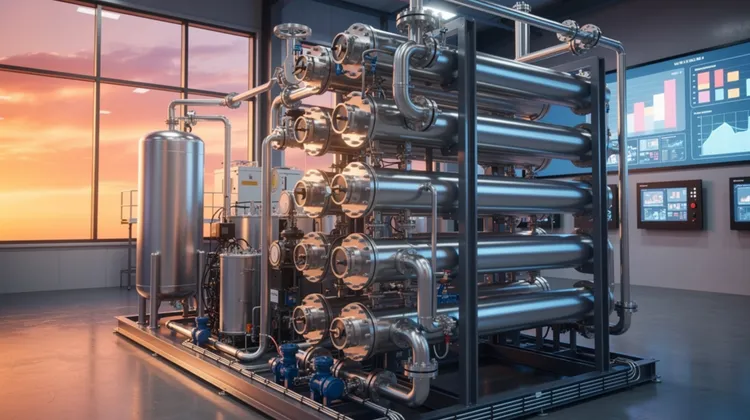
The promise of a hydrogen economy has long captivated energy strategists and industrial planners. Green hydrogen—produced via electrolysis powered by renewable energy—offers a pathway to decarbonize sectors that are notoriously difficult to electrify, such as steelmaking, chemical production, and heavy-duty transport. However, the transition from pilot projects to industrial-scale deployment hinges on a factor that often receives less attention than the electrolyzer itself: infrastructure. Without robust systems for high-pressure storage, safe transport, and reliable delivery to end users, the most efficient electrolysis plant remains an island of potential.
The challenge is not merely one of production volume. It is a logistical and engineering puzzle that requires rethinking how we move and store energy molecules. Unlike natural gas, hydrogen has a low volumetric energy density, meaning it must be compressed, liquefied, or chemically bonded to other substances to be economically viable for large-scale industrial use. This article examines the critical infrastructure components required to scale green hydrogen from electrolysis to heavy industrial applications, focusing on the technologies, standards, and investments that will define the next decade.
The Electrolysis Bottleneck: Production Is Only Half the Battle
While electrolysis technology has advanced rapidly—with proton exchange membrane (PEM) and solid oxide electrolyzers achieving efficiencies above 80%—the infrastructure to handle the output lags behind. A single 100 MW electrolysis facility can produce approximately 40 tons of hydrogen per day. To put that in perspective, a typical ammonia plant requires around 200 tons per day. Scaling up means building not just more electrolyzers, but also the storage and transport networks to match industrial demand.
- Storage Challenges: Hydrogen is the lightest element, with a density of just 0.09 kg/m³ at standard temperature and pressure. To store it in useful quantities, it must be compressed to 350–700 bar or liquefied at -253°C. Each method imposes significant energy penalties—compression consumes 10–15% of the hydrogen’s energy content, while liquefaction can consume up to 30%.
- Transport Constraints: Existing natural gas pipelines are often unsuitable for hydrogen due to embrittlement of steel, leakage through seals, and the need for different compression technologies. Dedicated hydrogen pipelines or repurposed infrastructure with specialized coatings and materials are required.
High-Pressure Storage: The Backbone of Industrial Supply
For industrial users, hydrogen is typically delivered at high pressure (200–700 bar) for direct use in processes like hydrotreating in refineries or as a feedstock for ammonia synthesis. Storage solutions must balance capacity, cost, and safety.
- Type I to Type IV Storage Tanks: Traditional steel tanks (Type I) are heavy and prone to embrittlement. Modern Type IV tanks, made from carbon fiber composites with polymer liners, offer higher pressure ratings (up to 700 bar) and lighter weight, making them ideal for stationary storage at industrial sites.
- Underground Storage: For seasonal or large-scale storage, salt caverns and depleted gas reservoirs offer the most cost-effective solution. A single salt cavern can store 1,000 tons of hydrogen at pressures of 100–200 bar. This approach is already used in the UK and the US Gulf Coast, but requires suitable geological formations.
- Metal Hydride Storage: For niche applications, metal hydrides can absorb hydrogen at low pressure and release it when heated. While less energy-dense than compressed gas, they offer safety advantages and are being explored for backup power and remote industrial sites.
Pipeline Transport: The Missing Link
The most efficient way to move large volumes of hydrogen over land is via pipelines. However, the existing natural gas pipeline network, which spans over 3 million kilometers globally, is not a drop-in replacement. Hydrogen molecules are small enough to diffuse through steel, causing hydrogen embrittlement—a process where atomic hydrogen dissolves into the metal lattice, leading to cracking and failure.
- Material Solutions: New pipelines made from stainless steel or lined with polymers can resist embrittlement. Retrofitting existing pipelines with internal coatings or using low-alloy steels is also being tested, but costs remain high.
- Blending with Natural Gas: A transitional approach is to blend hydrogen into natural gas pipelines at concentrations of up to 20% by volume. This reduces the need for dedicated infrastructure while gradually building demand. However, industrial users requiring pure hydrogen—such as steelmakers using direct reduction—cannot tolerate blending.
- Compression Stations: Hydrogen requires specialized compressors, often using diaphragm or ionic liquid technology, to maintain pressure along pipelines. These are more expensive and less efficient than natural gas compressors, adding to operational costs.
Transport by Truck and Rail: Flexibility for Distributed Demand
For industrial users not connected to a pipeline, hydrogen must be transported as compressed gas in tube trailers or as cryogenic liquid in tankers. Each method has trade-offs.
- Compressed Gas Tube Trailers: These carry 250–1,000 kg of hydrogen at 250–500 bar. They are suitable for short distances (under 200 km) but are inefficient for bulk delivery due to the weight of the storage cylinders.
- Liquid Hydrogen Tankers: Liquid hydrogen has a density of 70.8 kg/m³, making it far more energy-dense than compressed gas. A single tanker can carry 4,000 kg. However, boil-off losses (1–3% per day) and the energy cost of liquefaction make this viable only for high-value applications or long distances.
- Rail Transport: For industrial clusters, rail cars carrying liquid hydrogen or compressed gas can move large volumes efficiently. Japan and Germany are investing in rail-based hydrogen logistics for their heavy industries.
Safety and Standards: The Regulatory Foundation
Industrial hydrogen infrastructure must meet stringent safety standards to prevent leaks, explosions, and embrittlement failures. The International Organization for Standardization (ISO) and the European Committee for Standardization (CEN) have developed guidelines for hydrogen storage, transport, and refueling stations.
- Leak Detection: Hydrogen is odorless and burns with a nearly invisible flame, making detection critical. Advanced sensors using palladium nanoparticles or thermal conductivity are deployed at storage and transport points.
- Pressure Relief Devices: Every storage tank and pipeline segment must have pressure relief valves to prevent overpressurization. These are designed to vent hydrogen safely to the atmosphere or to a flare stack.
- Material Testing: All components in contact with hydrogen must undergo testing for embrittlement resistance. This includes valves, seals, and gaskets, which are often the weakest points in a system.
The Economics of Scale: Cost Reductions Through Infrastructure
The cost of green hydrogen is currently $4–6 per kg, compared to $1–2 per kg for gray hydrogen from natural gas. Infrastructure accounts for 30–40% of this cost, depending on the delivery method. As production scales, the cost of storage and transport is expected to decline through:
- Standardization of Components: Common tank sizes, pipeline diameters, and connector interfaces reduce manufacturing costs.
- Shared Infrastructure: Industrial clusters, such as the Port of Rotterdam or the Gulf Coast Hydrogen Hub, can share storage and pipeline networks, spreading fixed costs across multiple users.
- Learning Curves: As with solar and wind, each doubling of installed capacity reduces costs by 10–15%. The global pipeline for electrolysis projects is expected to reach 200 GW by 2030, driving down infrastructure costs.
#