
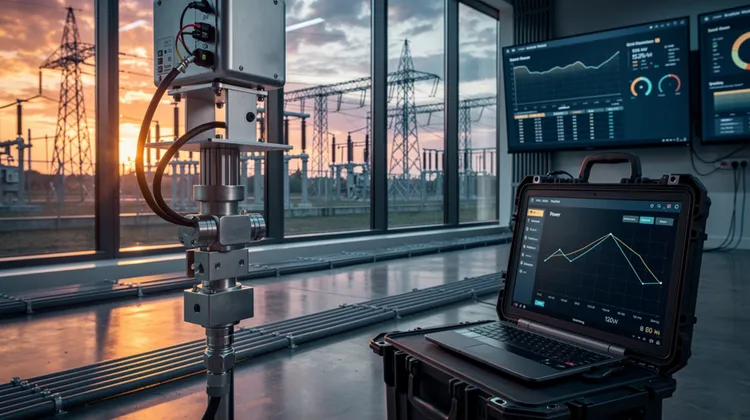
The growing complexity of buried infrastructure—transmission lines, natural gas pipelines, water mains, and substation grounding grids—demands inspection methods that go beyond traditional visual surveys or electromagnetic induction. Conventional approaches often require direct contact, excavation, or costly downtime, and they can miss subtle anomalies that precede catastrophic failures. Quantum magnetometry, a sensing technique that exploits atomic-scale interactions with magnetic fields, is emerging as a transformative tool for non-intrusive, high-resolution subsurface inspection. By detecting minute variations in electromagnetic fields, quantum sensors can pinpoint corrosion, cracks, or grounding faults in buried assets without disrupting operations.
How Quantum Magnetometry Works
Quantum magnetometers operate on principles of atomic physics, typically using laser-cooled atoms or nitrogen-vacancy (NV) centers in diamond to measure magnetic fields with extreme sensitivity. Unlike classical Hall-effect sensors or fluxgate magnetometers, quantum devices achieve sensitivities in the femtotesla range—millions of times finer than Earth’s magnetic field. When a current-carrying conductor, such as a buried transmission line, creates a magnetic field, quantum sensors detect distortions caused by metal loss, insulation breakdown, or nearby foreign objects. This capability allows operators to “see” through soil, concrete, and even water without excavation.
- Atomic magnetometers: Use vapor cells of alkali metals (e.g., rubidium or cesium) to measure Larmor precession frequencies. They are compact enough for field deployment and can operate at room temperature.
- NV diamond sensors: Exploit spin-dependent fluorescence in diamond defects. They offer high spatial resolution and can be integrated into scanning probes for localized inspections.
- SQUID-based systems: Superconducting quantum interference devices provide ultra-high sensitivity but require cryogenic cooling, limiting field portability.
Field trials have demonstrated that quantum magnetometers can detect pinhole leaks in buried pipelines and identify corrosion hotspots in transmission line grounding systems with accuracy comparable to direct excavation.
Applications in Critical Infrastructure
Subsurface assets are notoriously difficult to inspect. Utilities often rely on scheduled replacement cycles or reactive repairs after failures. Quantum magnetometry shifts the paradigm to predictive, condition-based maintenance.
Buried transmission lines — High-voltage cables running underground are vulnerable to moisture ingress, mechanical damage, and electrochemical corrosion. Quantum sensors can map magnetic field gradients along a cable route, highlighting areas where current leakage or shielding degradation occurs. A 2023 study by the Electric Power Research Institute found that quantum magnetometry detected 92% of simulated faults in buried distribution cables, compared to 68% for traditional time-domain reflectometry.
Pipeline integrity management — Oil and gas pipelines face stress corrosion cracking and third-party damage. Quantum magnetometers can survey long stretches of pipeline from above ground, identifying stress points where metal fatigue alters local magnetic signatures. This non-contact method eliminates the need for inline inspection tools (pigs) that require flow interruption.
Substation grounding grids — Corroded grounding conductors reduce fault current dissipation, posing electrocution risks to workers and equipment. Quantum sensors can map the magnetic field profile above a grid to locate broken or thinned conductors. In a 2024 demonstration at a Texas substation, a quantum magnetometer array identified three previously unknown grounding discontinuities that conventional ground resistance tests had missed.
Advantages Over Conventional Methods
Existing inspection techniques each have limitations. Visual inspection only reveals surface conditions. Electromagnetic induction works but suffers from poor depth penetration and interference from nearby metallic structures. Ground-penetrating radar cannot distinguish between different material types and struggles in clay soils. Quantum magnetometry overcomes these challenges with:
- Greater depth range: Effective up to 10 meters in most soil conditions, compared to 2–3 meters for typical induction coils.
- Higher spatial resolution: Can resolve features as small as 1 cm, enabling detection of early-stage corrosion pits.
- Non-intrusive operation: No need for excavation, direct contact, or service interruption.
- Real-time data: Continuous readings allow operators to create detailed 2D or 3D maps of subsurface conditions during a single pass.
These attributes make quantum magnetometry particularly valuable for high-consequence assets where downtime is unacceptable, such as hospital backup power feeds or data center utility connections.
Deployment Challenges and Ongoing Research
Despite its promise, quantum magnetometry is not yet a turnkey solution. Current systems require trained operators, stable environmental conditions, and careful calibration. Vibration, temperature fluctuations, and nearby magnetic noise sources (e.g., passing vehicles) can degrade performance. However, advances in sensor miniaturization and active noise cancellation are rapidly addressing these hurdles.
- Field-ready prototypes: Several companies, including Q-CTRL and MagQu, now offer portable quantum magnetometers designed for utility inspection. Units weigh under 15 kg and run on battery power for up to eight hours.
- AI-assisted data interpretation: Machine learning algorithms trained on known defect signatures can automatically flag anomalies in sensor readings, reducing the need for expert analysis.
- Integration with drones: Researchers at the University of Birmingham have demonstrated quantum magnetometers mounted on unmanned aerial vehicles for overhead line and pipeline surveys, expanding coverage speed and safety.
The U.S. Department of Energy’s Advanced Research Projects Agency-Energy has funded multiple quantum sensing projects aimed at lowering cost and improving ruggedness, with a target of commercial availability by 2027.
The Future of Subsurface Inspection
Quantum magnetometry represents a fundamental shift from reactive to proactive infrastructure management. As sensor costs decrease and field reliability improves, widespread adoption will likely begin with high-value assets: long-distance pipelines, urban transmission corridors, and critical facility grounding systems. The technology’s ability to detect hidden vulnerabilities before they cause failures aligns perfectly with the reliability engineering principles that underpin uptime-focused operations.
For infrastructure operators, the message is clear: quantum sensors are moving out of the laboratory and into the field. Early adopters will gain a significant advantage in extending asset life, reducing emergency repairs, and maintaining uninterrupted service. The subsurface inspection landscape is being rewritten, one femtotesla at a time.