
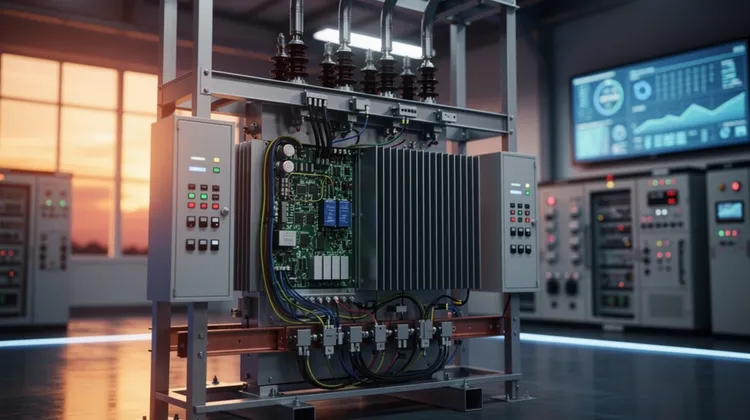
The electrical grid is undergoing a transformation as profound as the shift from analog to digital communications. At the heart of this evolution lies a technology that promises to rewrite the rules of power distribution: the solid-state transformer. For over a century, the humble iron-core transformer has been a workhorse of the grid, stepping voltages up and down with remarkable reliability. But as the grid becomes smarter, more distributed, and increasingly reliant on renewable energy and DC loads, the limitations of traditional magnetic transformers are becoming apparent. Solid-state transformers (SSTs) are emerging not just as an upgrade, but as a fundamental rethinking of what a transformer can do.
What Makes Solid-State Transformers Different?
Traditional transformers operate on electromagnetic induction, using a magnetic core to transfer energy between windings. They are passive, robust, and inherently efficient for simple voltage conversion. However, they offer no control over power flow, no ability to regulate voltage dynamically, and no way to handle the complexities of modern grids—like integrating solar panels, battery storage, or electric vehicle chargers that operate on DC.
SSTs replace the magnetic core and copper windings with high-frequency power electronics—typically insulated-gate bipolar transistors (IGBTs) or silicon carbide (SiC) MOSFETs. These semiconductors switch on and off at extremely high frequencies, allowing the SST to convert AC to DC, then back to AC, or direct DC to DC, all while precisely controlling voltage, current, and frequency. This active control is the game-changer.
Why Grid Operators Are Paying Attention
The global push for decarbonization and grid modernization has made SSTs a hot topic in utility boardrooms and engineering conferences alike. Here are the primary drivers behind their rise:
- Voltage Regulation Without Taps: Traditional transformers use tap changers to adjust output voltage, a mechanical process that is slow, wears out over time, and offers limited granularity. SSTs can adjust voltage in microseconds, compensating for fluctuations from intermittent renewables or sudden load changes. This maintains power quality within tighter tolerances, a critical requirement for sensitive industrial equipment and data centers.
- Direct DC Integration: The modern grid is increasingly DC-based. Solar panels produce DC. Battery storage systems store DC. Electric vehicle batteries charge on DC. Data centers and many industrial drives use DC internally. With an SST, these loads and sources can be connected directly, eliminating multiple AC-to-DC conversion steps. Each conversion step loses 2-5% of energy; eliminating them can improve overall system efficiency by 5-10%.
- Bidirectional Power Flow: Smart grids require power to flow in both directions—from the central plant to the consumer, but also from rooftop solar or vehicle-to-grid systems back to the utility. SSTs handle bidirectional flow natively, enabling distributed energy resources to participate in grid services like frequency regulation and peak shaving.
- Improved Power Quality: SSTs can actively filter harmonics, correct power factor, and isolate sensitive loads from grid disturbances. A single SST can replace a transformer plus a power quality conditioner, reducing footprint and cost.
How SSTs Improve Grid Stability
Grid stability is not just about keeping the lights on; it is about maintaining frequency and voltage within strict operational limits. Traditional grids rely on the inertia of large rotating generators to dampen fluctuations. As those generators are replaced by inverter-based renewables, that inertia disappears, creating new stability challenges.
SSTs offer a solution through their fast-acting control loops. They can inject or absorb reactive power in real time, mimicking the behavior of synchronous condensers. In microgrid applications, SSTs can island a section of the grid seamlessly, ensuring critical loads remain powered during a blackout. Utilities are beginning to deploy SSTs in strategic locations—such as substations serving industrial parks or commercial districts—to act as firewalls against disturbances.
The Role of Wide-Bandgap Semiconductors
The practical realization of SSTs hinges on advancements in wide-bandgap semiconductors, particularly silicon carbide (SiC) and gallium nitride (GaN). These materials can withstand higher voltages, operate at higher temperatures, and switch at higher frequencies than traditional silicon. For an SST intended for distribution-level voltages (typically 11-33 kV), SiC devices are essential because they reduce switching losses and allow for more compact thermal management. The result is a transformer that is smaller, lighter, and more efficient than its iron-core equivalent—while offering vastly more functionality.
Challenges to Adoption
Despite their promise, SSTs are not yet mainstream. Several hurdles remain:
- Cost: Power electronics are still more expensive than copper and iron for equivalent power ratings. However, as semiconductor manufacturing scales and new materials become cheaper, the cost gap is narrowing.
- Reliability: Traditional transformers have a service life of 30-40 years with minimal maintenance. SSTs contain dozens of active components that could fail, raising concerns about long-term reliability. Manufacturers are addressing this through redundancy and advanced monitoring, but the track record is still short.
- Thermal Management: Even with efficient SiC devices, SSTs generate heat that must be managed. In confined substations or indoor applications, cooling can be a design challenge.
- Standards and Grid Interoperability: Existing grid infrastructure is built around the characteristics of magnetic transformers. Integrating SSTs requires updated protection schemes, communication protocols, and testing standards. Work is underway through IEEE and IEC committees to develop these standards.
Real-World Deployments
The technology is moving from the lab to the field. In 2023, a major European utility deployed a 1 MVA SST in a substation serving a mix of residential, commercial, and EV charging loads, reporting a 6% improvement in energy efficiency and a 15% reduction in voltage fluctuations. In North America, a microgrid project in California uses SSTs to tie together solar arrays, battery storage, and a fleet of electric buses, demonstrating seamless islanding and black-start capability. These early adopters are building the case for wider deployment.
The Future of Grid Architecture
Looking ahead, solid-state transformers are not merely an incremental improvement. They represent a shift toward a fully controllable, software-defined grid. Imagine a Transformer 2.0 that can be reconfigured remotely, that communicates with grid operators and smart meters, and that can adapt its behavior to optimize for efficiency, reliability, or renewable penetration as needed. That is the promise of SSTs.
As the cost of power electronics continues to decline and wide-bandgap devices achieve higher voltage ratings, there will be a tipping point where SSTs become the default choice for new grid installations. The traditional iron-core transformer will not disappear overnight, but its dominance is fading. For engineers, planners, and operators focused on uptime and resilience, the solid-state transformer is the most exciting development in power distribution in decades. The grid of tomorrow will be smarter, more efficient, and more stable—and it will be built on solid-state foundations.