
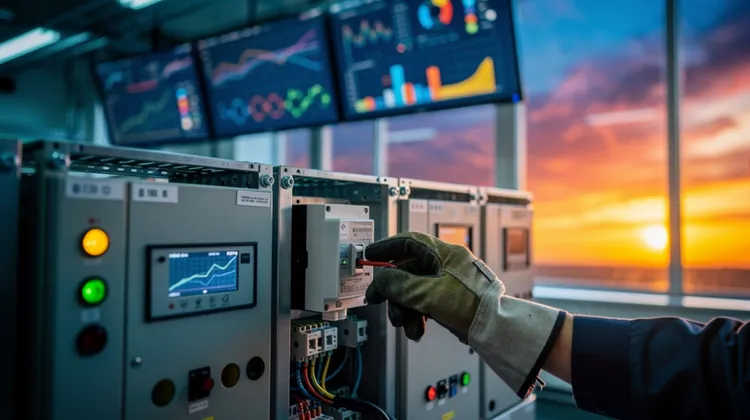
Arc flash incidents remain one of the most dangerous and costly electrical hazards in industrial facilities. For years, the primary defense against these catastrophic events has been personal protective equipment—flame-resistant clothing, face shields, and insulated tools. While safety gear is undeniably necessary, it is essentially a last line of defense. True protection begins upstream, at the design of the power system itself. By reducing incident energy at the source through intelligent system design, facilities can drastically lower the severity of arc flash events, if not eliminate the hazard altogether. This approach shifts the safety paradigm from merely surviving an explosion to preventing its destructive force.
The physics of an arc flash are driven primarily by two factors: the available fault current and the fault-clearing time. Higher fault currents and longer clearing times result in exponentially greater incident energy. Traditional safety strategies often focus on the latter—specifying faster-acting protective devices. However, system design offers a more powerful lever: limiting the energy available to feed an arc in the first place. Two of the most effective design-based strategies are the deployment of maintenance switches and the systematic optimization of circuit breaker settings.
The Psychology of Relying on PPE
Before diving into design solutions, it is important to understand why over-reliance on PPE is problematic. Each layer of protective gear introduces physical limitations. Arc-rated hoods restrict peripheral vision and raise heat stress. Heavy gloves reduce dexterity and tactile feedback. In a live electrical environment, these compromises can actually increase the risk of human error. More critically, PPE does nothing to prevent the incident from happening—it only mitigates the outcome. A worker in full arc-rated gear who misreads a panel and causes a phase-to-phase fault will still face a violent explosion, though perhaps survive. The goal of system-level design is to ensure that even if an operator makes a mistake, the resulting energy is below a threshold that demands special PPE, or better yet, is negligible.
Maintenance Switches: A Temporary but Vital Tool
One of the most practical innovations in arc flash reduction is the maintenance switch. This device, often integrated into modern low-voltage and medium-voltage circuit breakers, is a simple selector that temporarily overrides long-time and short-time protective settings. When activated, the maintenance switch forces the breaker to trip at a substantially lower overcurrent threshold—often near 0.5 times the nominal rating—and with minimal intentional delay.
Why is this useful? Consider a typical motor control center feeding a 100-horsepower motor. Under normal operation, that motor draws around 100 amps during start-up, so the breaker’s long-time pickup is set around 250 amps with a delay of several seconds to allow the motor to accelerate. If an arc flash occurs while that breaker is set for normal operation, the fault may persist for over a second before the breaker trips—releasing massive incident energy. With the maintenance switch engaged, the breaker will trip in less than 0.1 seconds at a lower current limit, reducing incident energy from, say, 40 cal/cm² to under 4 cal/cm².
The key is that maintenance switches are intended for use during periods of increased risk, such as when an electrician is racking the breaker in or out, or performing voltage testing. They are not meant for permanent activation, as frequent nuisance tripping could occur from normal load variations. However, their temporary deployment dramatically transforms the risk profile of high-energy tasks.
Modern Circuit Breaker Settings: The Precision Approach
Even without a dedicated maintenance switch, modern electronic trip units offer unprecedented flexibility in shaping protective curves. Engineers can now program multiple setting groups, allowing the protective device to behave differently depending on whether the system is in normal operation or a maintenance mode. This is accomplished through digital communication protocols like Modbus or via local programming.
For example, a medium-voltage circuit breaker feeding a transformer can be set with two distinct profiles. Under normal conditions, the breaker allows high inrush currents during transformer energization without tripping. But when a worker enters the downstream switchgear, a remote signal from a portable station or a fixed safety interlock switches the breaker to a faster, lower-current mode. Some systems even base this on measured load current, automatically switching to a more sensitive mode if the load is minimal—indicating that a human is likely performing work.
Beyond dual settings, modern breakers permit fine-tuning of time-current curves. The short-time pickup and delay can be reduced by one to two cycles, which for a typical 20-cycle fault could cut incident energy by half. Coordinating these settings downstream also prevents upstream breakers from delaying unnecessarily—a problem that often arises when engineers add safety margins without verifying system impact.
Incident Energy Reduction Through Proper Coordination
Another critical design element is selective coordination. Poorly coordinated protective devices can cascade a downstream fault into an upstream breaker, subjecting a larger portion of the system to the fault energy and prolonging the clearing time. By carefully tuning time-delay settings and ensuring that each breaker responds only to its own zone, incident energy at worker locations can be minimized.
A well-executed coordination study, updated at least every five years or after any significant system change, is the foundation. It identifies the magnitude of available fault current at each point and ensures that protective devices open before the arc flash threshold is reached. For new installations, engineers should always specify the lowest available interrupting ratings consistent with the system’s normal operation, as higher-rated breakers sometimes have slower response times due to mechanical inertia.
Real-World Statistics and Impact
The financial and human cost of arc flash incidents is staggering. According to the Electrical Safety Foundation International, arc flash events cause an estimated 5 to 10 arc flash explosions every day in the United States, resulting in severe burns, permanent disability, or death. The average cost of a single severe arc flash incident is between $8 million and $15 million when factoring in downtime, equipment repair, litigation, and increased insurance premiums.
Industrial facilities that have implemented system-level arc flash mitigation—including maintenance switches and advanced breaker settings—report reductions in incident energy levels of 50 to 80 percent at critical work locations. One case study from a large petrochemical plant in Texas showed that after retrofitting their medium-voltage switchgear with maintenance switches and reprogramming trip units, the highest incident energy label dropped from 65 cal/cm² to 12 cal/cm² across the facility, enabling many tasks to be performed at a lower PPE level.
Integrating Technology with Operational Practices
The most effective programs marry hardware design with operational discipline. Maintenance switches are only useful if workers are trained to use them correctly and reliably. Many facilities implement a simple procedure: before any live work is performed, the technician must walk to the breaker and engage the switch while a second person verifies the action. Digital monitoring systems can also log when the switch is active, providing an audit trail for safety compliance.
Similarly, the programming of multiple setting groups should be documented and reviewed annually. As load conditions change or new equipment is added, the previously calculated settings may no longer provide optimal protection. A live arc flash study should be performed whenever a breaker’s trip unit is replaced or when significant load additions occur.
#