
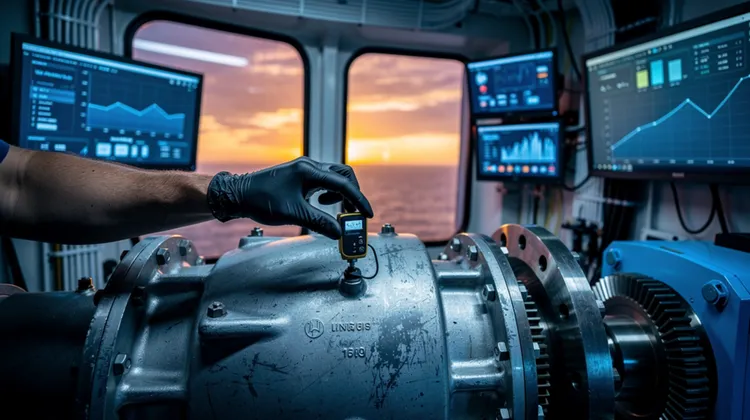
The cost of maintaining offshore wind turbines is staggering. A single gearbox failure can cost upwards of $500,000 in repairs and lost revenue, not to mention the logistical nightmare of mobilizing a jack-up vessel and crew in unpredictable sea conditions. For decades, operators relied on scheduled maintenance—replacing parts at fixed intervals regardless of actual condition. But the industry is now turning to a smarter approach: AI-driven predictive maintenance.
By processing streams of acoustic, vibration, and thermal data in real time, machine learning models can detect the earliest signs of wear in critical components like gearboxes, blades, and bearings. This isn’t just about avoiding breakdowns—it’s about fundamentally changing how offshore wind farms are managed.
The High Cost of Unplanned Downtime
Offshore wind turbines operate in some of the harshest environments on earth. Saltwater corrosion, extreme wind speeds, and constant vibration take a heavy toll. According to a 2023 study by the National Renewable Energy Laboratory (NREL), unplanned downtime accounts for 25–30% of total operational costs for offshore wind farms. A single major failure can keep a turbine offline for weeks.
Traditional maintenance strategies are reactive—wait for a component to fail, then fix it. This approach is not only expensive but dangerous. Sending technicians offshore in rough weather to perform emergency repairs poses significant safety risks. The alternative, time-based preventive maintenance, often leads to unnecessary part replacements and wasted resources.
How AI Models Predict Failures Before They Happen
Predictive maintenance flips the script. Instead of relying on fixed schedules, it uses data to determine exactly when a component needs attention. Machine learning algorithms are trained on historical failure data and real-time sensor inputs to identify patterns that precede breakdowns.
Three types of data are particularly valuable:
- Acoustic data: Microphones installed inside the nacelle capture high-frequency sounds from gear meshing and bearing rotation. A shift in frequency or amplitude often signals tooth wear or pitting.
- Vibration data: Accelerometers measure changes in vibration patterns. Gearbox faults, for example, produce distinct signatures in the 1–10 kHz range.
- Thermal data: Infrared cameras and thermocouples monitor temperature gradients. A hot spot on a blade or gearbox can indicate friction from impending failure.
These data streams are fed into a machine learning model—often a convolutional neural network (CNN) or a long short-term memory (LSTM) network—that learns to correlate sensor anomalies with specific failure modes. Once trained, the model can issue alerts days or even weeks before a catastrophic failure occurs.
Real-World Applications and Results
Several offshore wind operators are already deploying AI-driven predictive maintenance with measurable success. In the North Sea, a major operator used vibration analysis to detect early-stage gearbox wear in a 6 MW turbine. The model flagged a 0.5 mm crack in a gear tooth three weeks before it would have caused a complete failure. The repair was scheduled during a calm weather window, saving an estimated $200,000 in emergency vessel costs.
Another project in the Baltic Sea used acoustic monitoring to identify blade fatigue. The system detected a change in the sound signature of a blade during low-wind conditions. Inspection revealed delamination at the trailing edge. The blade was repaired in situ, avoiding a full replacement that would have cost over $100,000.
These examples highlight a key advantage: predictive maintenance allows operators to plan interventions during favorable conditions, reducing both cost and risk.
Challenges in Implementation
Despite the promise, deploying AI-driven predictive maintenance offshore is not without hurdles.
- Data quality: Sensors must withstand salt spray, extreme temperatures, and vibration. Corrosion or calibration drift can corrupt data. Redundant sensor arrays and robust signal processing are essential.
- Model accuracy: False positives are costly—they trigger unnecessary inspections. False negatives are worse. Models must be trained on large, labeled datasets, which are scarce for rare failure modes.
- Connectivity: Offshore turbines often have limited bandwidth. Edge computing—processing data locally on the turbine—reduces the need for constant cloud uploads. Models run on embedded GPUs or FPGAs inside the nacelle.
Best Practices for Offshore Wind Farms
To successfully implement AI-driven predictive maintenance, operators should follow these guidelines:
- Start with critical components: Focus on gearboxes, blades, and main bearings. These have the highest failure costs and the most available historical data.
- Use hybrid models: Combine physics-based models (which understand mechanical stress) with data-driven AI models. This improves accuracy and reduces false alarms.
- Invest in edge computing: Process data locally to avoid bandwidth bottlenecks. Only send anomaly alerts and summary statistics to shore.
- Build a feedback loop: Every maintenance action should be logged and fed back into the model. This continuous learning improves prediction accuracy over time.
The Future of Offshore Wind Maintenance
As AI models become more sophisticated, the scope of predictive maintenance will expand. Researchers are exploring the use of digital twins—virtual replicas of physical turbines that simulate wear under different conditions. Combined with real-time sensor data, digital twins can predict not just when a component will fail, but how it will fail, allowing for more precise spare parts planning.
The economics are compelling. A 2024 report from Wood Mackenzie estimates that widespread adoption of AI-driven predictive maintenance could reduce offshore wind operational costs by 20–30% by 2030. For a 500 MW wind farm, that translates to annual savings of $5–10 million.
Offshore wind is already a cornerstone of the global energy transition. Making it more reliable and cost-effective is not just a technical goal—it’s an economic and environmental imperative. AI-driven predictive maintenance is proving to be one of the most powerful tools in achieving that mission.