
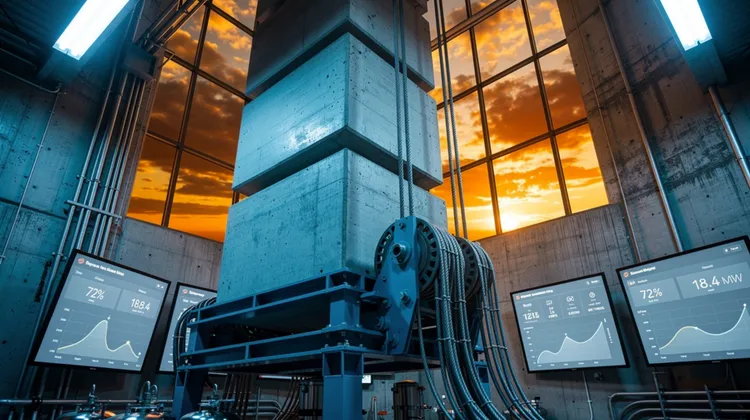
The global energy landscape is undergoing a seismic shift. As renewable sources like solar and wind become dominant, the intermittent nature of their generation presents a fundamental challenge: how do you power a city when the sun doesn’t shine or the wind doesn’t blow for days? The current answer, lithium-ion batteries, excels at short-duration bursts of power—typically two to four hours. But for true grid resilience and deep decarbonization, that’s insufficient. The industry is now pivoting toward long-duration energy storage (LDES), a category of technologies capable of discharging power for eight hours, a full day, or even a week. This shift is not merely incremental; it is foundational to the reliability of critical infrastructure.
The Limitations of Lithium-Ion for Multi-Day Storage
Lithium-ion batteries are the workhorses of modern energy storage, dominating everything from electric vehicles to data center backup. Their high energy density and rapid response times are unmatched. However, for multi-day storage, lithium-ion faces significant hurdles. The cost of scaling lithium-ion to provide 100+ hours of backup is prohibitive, as it requires massive banks of cells that degrade over time with deep cycling. Beyond economics, there are operational constraints. Lithium-ion systems self-discharge at a rate of roughly 1-5% per month, making them inefficient for multi-week storage. For critical infrastructure operators—hospitals, data centers, industrial facilities—a solution that can hold a charge for days without significant loss is essential.
Iron-Air Batteries: The Chemistry of Rust
One of the most promising contenders in the LDES arena is the iron-air battery. Developed by companies like Form Energy, this technology leverages the simple chemistry of iron rusting. During discharge, iron reacts with oxygen to form rust, releasing electrons. During charging, an electrical current reverses the reaction, converting rust back to iron. The key advantage is cost: iron is abundant, cheap, and non-toxic. These batteries can store energy for up to 100 hours at a fraction of the cost of lithium-ion. For industrial facilities that need multi-day backup during extreme weather events or grid outages, iron-air offers a scalable, safe alternative. The trade-off is lower round-trip efficiency—around 50%—but for long-duration applications, the economics favor storage capacity over efficiency.
Flow Batteries: Scalable and Non-Degrading
Flow batteries offer another compelling path forward. Unlike solid-state lithium cells, flow batteries store energy in liquid electrolytes held in external tanks. Vanadium redox flow batteries are the most mature technology, offering a lifespan of 20+ years with no degradation in capacity. The power and energy capacity are decoupled—larger tanks mean more storage hours without increasing the electrochemical stack. This modularity makes flow batteries ideal for applications requiring 4-12 hours of discharge. For healthcare technology and data center infrastructure, where uptime is non-negotiable, flow batteries provide a predictable, long-life solution. The main challenge remains upfront capital cost, though vanadium prices have stabilized, and new chemistries like iron-chromium are driving costs down.
Gravity and Mechanical Storage: Raising the Stakes
Not all LDES solutions rely on electrochemistry. Gravity storage, pioneered by companies like Energy Vault and Gravitricity, uses excess renewable energy to lift massive weights—concrete blocks or steel pistons—and then releases them to generate power when needed. These systems have no chemical degradation, no thermal runaway risk, and can store energy for days with minimal loss. The efficiency is competitive with pumped hydro, around 70-80%. For outdoor power infrastructure in remote locations, gravity storage offers a rugged, low-maintenance alternative. Another mechanical approach is compressed air energy storage (CAES), which stores energy by compressing air in underground caverns or tanks. Modern adiabatic CAES systems capture the heat of compression and reuse it during expansion, achieving round-trip efficiencies above 70%. These systems are ideal for multi-day storage at utility scale.
Thermal Energy Storage: Heat as a Battery
For industrial processes that require heat rather than electricity, thermal energy storage is a game-changer. Systems like those from Malta Inc. use molten salt or ceramic materials to store heat at high temperatures, which can then be converted back to electricity via a turbine. This approach is particularly valuable for combined heat and power (CHP) facilities in manufacturing and healthcare. Thermal storage can provide 10-24 hours of backup, bridging the gap between peak renewable generation and round-the-clock industrial demand. The technology is mature—concentrated solar power plants have used molten salt for years—and is now being adapted for grid-scale storage.
Integration and Reliability for Critical Infrastructure
For Uptime Warriors, the adoption of LDES is not just about cost or efficiency; it is about reliability. A hospital’s backup power system must sustain life-critical equipment for days, not hours. A data center’s UPS must bridge the gap until generators start, and those generators need fuel. LDES can reduce or eliminate the need for diesel generators, lowering both emissions and maintenance burdens. The integration of these technologies with existing switchgear and control systems is a growing focus for electrical engineers. Standards for communication protocols, safety ratings, and grid interconnection are being developed to ensure seamless operation.
Key Considerations for Adoption
- Cost per kWh Delivered: For multi-day storage, the levelized cost of storage (LCOS) is more important than upfront capital. Iron-air and gravity systems currently lead on this metric.
- Round-Trip Efficiency: Lower efficiency technologies (iron-air at 50%) are acceptable for long-duration because the energy stored is often cheap renewable surplus.
- Safety and Thermal Management: Flow batteries and gravity systems have no thermal runaway risk, making them safer for urban or sensitive environments.
- Scalability: Flow and gravity systems scale linearly with tank size or weight. Lithium-ion requires adding entire battery racks, driving up complexity.
- Operational Lifespan: Flow batteries can last 20+ years; lithium-ion typically 10-15 years with capacity degradation.
The Road Ahead
The LDES market is projected to grow from $3.5 billion in 2024 to over $50 billion by 2035, according to Bloomberg NEF. Major utilities and industrial operators are already piloting these systems. The U.S. Department of Energy’s Long Duration Storage Shot aims to reduce the cost of LDES by 90% by 2030, targeting $0.05 per kWh. For critical infrastructure, the implications are profound. Multi-day energy storage will enable microgrids to operate independently for extended periods, protect against prolonged grid outages, and support the electrification of industrial processes.
The future of energy storage is not a single technology but a portfolio of solutions tailored to specific durations and use cases. Lithium-ion will continue to dominate for short bursts, but for the multi-hour and multi-day discharge that true grid resilience demands, the solutions are emerging from chemistry, gravity, and heat. As these technologies mature, they will become integral to the backbone of reliable, clean power for the world’s most critical infrastructure.